


Senescence to nutrient cycling: Top-down effects of climate change
Plant Science Research WeeklyPrecipitation plays an important role in shaping leaf tissue composition, and as climate change progresses, we’ll likely see dramatic shifts in precipitation regimes. Changes in leaf tissue composition due to increased rainfall or drought may have cascading effects on soil microbe communities and ultimately…
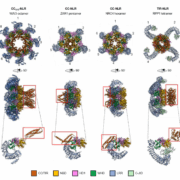
A wheat immune receptor that breaks the mold: The octameric WAI3 resistosome
Plant Science Research WeeklyPlants may not have white blood cells, but they are far from defenseless. Instead, they rely on specialized immune receptors called NLRs (nucleotide-binding leucine-rich repeat receptors) to recognize intracellular invaders and trigger strong defense responses. These receptors are molecular shape-shifters,…
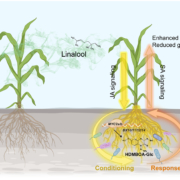
Signals in the air and soil: the hidden communication circuit that shapes plant resilience
Plant Science Research WeeklyWhen plants grow shoulder to shoulder in crowded fields, they don’t just compete for space and sunlight—they also “talk” to one another. This underground and airborne chatter, carried by leaf volatiles and root exudates, helps plants sense nearby neighbors and prepare for threats. But how exactly…
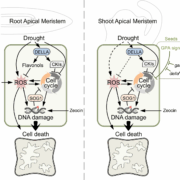
More than a trade-off: how growth inhibition protects plant genome integrity
Plant Science Research WeeklyWhen plants face tough times, like an invading pathogen or a sudden drought, they often make a difficult choice: pause growth to focus on survival. This phenomenon, called the growth–defense trade-off, has long been thought to result from limited resources – plants simply can’t do everything at…
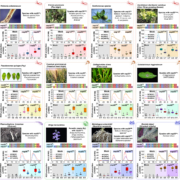
Plant Science Research Weekly, September 12, 2025
Plant Science Research WeeklyReview: Plant receptor-like kinases sense extrinsic and host-derived signals and shape the microbiome
Plant genomes contain hundreds of genes encoding receptor-like kinases (RLKs), which are membrane-spanning proteins with an extracellular perception domain and an intracellular signaling domain. Many…
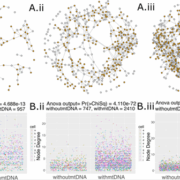
Running on empty: How does the absence of mtDNA shape mitochondrial movement and connectivity?
Plant Science Research WeeklyMitochondria move within cells to support bioenergetic function and enable sharing of content, including mitochondrial DNA (mtDNA). Since not all plant mitochondria carry a full set of, or any mtDNA, sharing may allow genetic material to spread across the population. This creates a connected network…
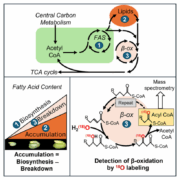
Beyond storage: Active lipid turnover shapes seed oil metabolism
Plant Science Research WeeklyFor decades, plant lipid research followed a simple narrative: seeds accumulate oil during development, then break it down after germination to fuel seedling growth. In a landmark study, Koley et al. overturn this binary view with compelling evidence that lipid metabolism is far more dynamic than previously…
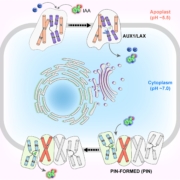
First structure of the AUX1 auxin importer resolved
Plant Science Research WeeklyPolar auxin transport is central to plant development, relying on coordinated activity of influx carriers (AUX/LAX), efflux carriers (PINs), and ABCB transporters. While structural insights and transport mechanism of PIN proteins has been available, those of the AUX/LAX family have remained unresolved.…
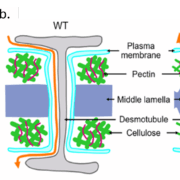
Open Sesame! Pectin tweaks plasmodesmata to control root transport
Plant Science Research WeeklyIn plants, plasmodesmata provide essential symplastic connections for the movement of nutrients and signals. While their role in developing roots is well established, whether they contribute significantly to radial nutrient transport once roots are fully differentiated is still poorly understood. To…