
ZmWAK3 acts as a negative regulator of drought tolerance in maize
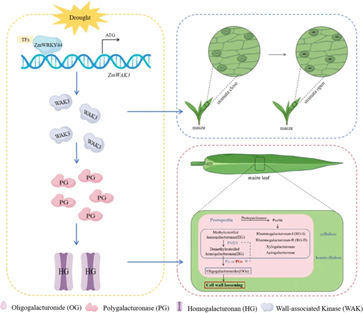 Drought is a major constraint on maize production, and understanding the underlying molecular regulators is key to breeding resilient varieties. Yang et al. investigated the role of the wall-associated kinase ZmWAK3 in maize seedlings and found it to be a negative regulator of drought tolerance. Loss-of-function mutants (zmwak3) survived drought stress better, showing higher photosynthetic efficiency, enhanced antioxidant activity, and improved cell wall integrity. In contrast, overexpression lines were more sensitive, with weakened walls, greater water loss, and reduced survival. Mechanistically, ZmWAK3 promotes polygalacturonase activity, leading to pectin degradation and cell wall loosening, which compromises water retention. It also impairs stomatal closure, thereby accelerating transpiration under drought. Conversely, mutants retained more pectin and displayed faster stomatal closure, reducing water loss. The transcription factor ZmWRKY44 directly binds the ZmWAK3 promoter, activating its expression under drought conditions. Silencing ZmWRKY44 lowered ZmWAK3 levels and improved drought tolerance, mimicking the mutant phenotype. Population analysis revealed natural variation at the ZmWAK3 locus, and the authors developed a functional marker (ZmWAK3-177) that reliably distinguishes drought-tolerant alleles. This provides a valuable tool for marker-assisted selection in maize breeding. Overall, this study uncovers a ZmWRKY44–ZmWAK3 regulatory module that links cell wall remodeling and stomatal dynamics to drought sensitivity. It highlights ZmWAK3 as both a mechanistic target and a breeding marker for developing maize varieties with improved drought resilience. Summary by Muhammad Aamir Khan (@MAKNature1998) Theor. Appl. Genet. 10.1007/s00122-025-05019-2