Auxin regulates rice root angle through OsILA1-driven cell wall remodeling
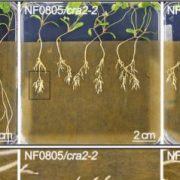
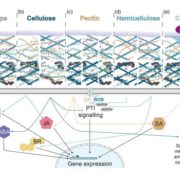
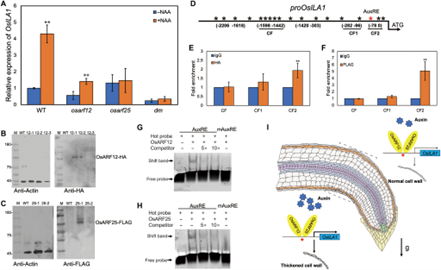 Root angle is the direction and spatial orientation of roots in relation to gravity, which aids nutrient uptake and anchorage. Root angle is shaped by gravity perception, asymmetric auxin distribution, and differential growth across root zones. While auxin response factors (ARFs) are known to regulate this process, their downstream targets remain unclear. Song et al. identified OsILA1, which encodes a Raf-like mitogen-activated protein kinase, as specifically expressed in the rice root epidermis, suggesting a role in root development. The authors tested this hypothesis with gravistimulation assays. In wild-type (WT) plants, gravistimulation triggers cell wall thickening on the lower side of the root, putting a brake on elongation and causing the root to bend downwards. By contrast, cell wall thickening was absent in the lower side of osila1 mutant roots, causing delayed response to gravity. Similarly, auxin treatments showed that high NAA concentrations inhibited root elongation and promoted cell wall thickening in WT roots, a response that was absent in osila1 mutants, suggesting a direct connection between auxin and wall remodeling. Since auxin response elements (AuxREs) are found in the OsILA1 promoter, the authors tested their function using a complementation assay and showed that the OsILA1 promoter requires the AuxRE to restore gravitropic responses in osila1 mutants. Because AuxREs are regulated by ARFs, the authors mutated all nine activator OsARFs and found that osarf12 and osarf25 mutants had shallower roots and reduced OsILA1 expression. Overall, this study provides the mechanism by which auxin regulates cell growth during root gravitropic response. (Summary by Irene I. Ikiriko @ireneikiriko) Science Advances 10.1126/sciadv.ady23.