

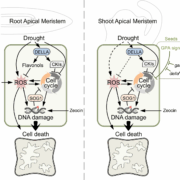
More than a trade-off: how growth inhibition protects plant genome integrity
Plant Science Research WeeklyWhen plants face tough times, like an invading pathogen or a sudden drought, they often make a difficult choice: pause growth to focus on survival. This phenomenon, called the growth–defense trade-off, has long been thought to result from limited resources – plants simply can’t do everything at…
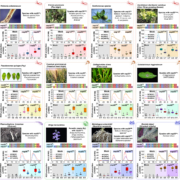
Plant Science Research Weekly, September 12, 2025
Plant Science Research WeeklyReview: Plant receptor-like kinases sense extrinsic and host-derived signals and shape the microbiome
Plant genomes contain hundreds of genes encoding receptor-like kinases (RLKs), which are membrane-spanning proteins with an extracellular perception domain and an intracellular signaling domain. Many…
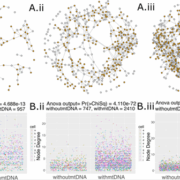
Running on empty: How does the absence of mtDNA shape mitochondrial movement and connectivity?
Plant Science Research WeeklyMitochondria move within cells to support bioenergetic function and enable sharing of content, including mitochondrial DNA (mtDNA). Since not all plant mitochondria carry a full set of, or any mtDNA, sharing may allow genetic material to spread across the population. This creates a connected network…
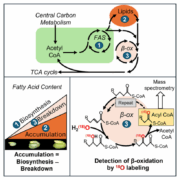
Beyond storage: Active lipid turnover shapes seed oil metabolism
Plant Science Research WeeklyFor decades, plant lipid research followed a simple narrative: seeds accumulate oil during development, then break it down after germination to fuel seedling growth. In a landmark study, Koley et al. overturn this binary view with compelling evidence that lipid metabolism is far more dynamic than previously…
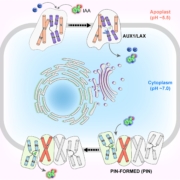
First structure of the AUX1 auxin importer resolved
Plant Science Research WeeklyPolar auxin transport is central to plant development, relying on coordinated activity of influx carriers (AUX/LAX), efflux carriers (PINs), and ABCB transporters. While structural insights and transport mechanism of PIN proteins has been available, those of the AUX/LAX family have remained unresolved.…
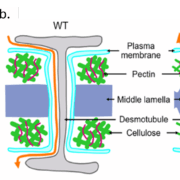
Open Sesame! Pectin tweaks plasmodesmata to control root transport
Plant Science Research WeeklyIn plants, plasmodesmata provide essential symplastic connections for the movement of nutrients and signals. While their role in developing roots is well established, whether they contribute significantly to radial nutrient transport once roots are fully differentiated is still poorly understood. To…
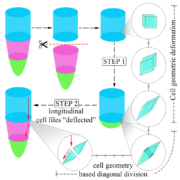
Divide and conquer : How roots adjust division to restore shape after wounding
Plant Science Research WeeklyA fascinating biological phenomenon is where a root tip can be surgically removed at a distance from the stem cell niche, yet the root still robustly grows back to its initially tapered shape. Mathew et al. investigated the cellular mechanism for how root regeneration can re-develop this tapered shape…
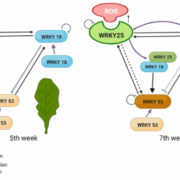
Redox-driven WRKY25 unlocks WRKY53 to orchestrate leaf senescence
Plant Science Research WeeklyLeaf senescence, which overlaps with the reproductive growth phase in annual plants, constitutes the last stage in the development of a leaf, and several endogenous and exogenous factors control this, ultimately influencing the plant’s fitness, crop yield quantity and quality. The WRKY family of transcription…
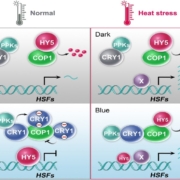
Turning down the heat: A photoreceptor-based repression of plant thermotolerance
Plant Science Research WeeklyPlants use several photoreceptors to perceive light including the cryptochromes (CRYs), which are implicated in blue-light reception and coordinate developmental processes including photomorphogenesis. Here, Liu et al. shed light on how light and temperature cues simultaneously affect plants. They identified…