

Turning down the heat: A photoreceptor-based repression of plant thermotolerance
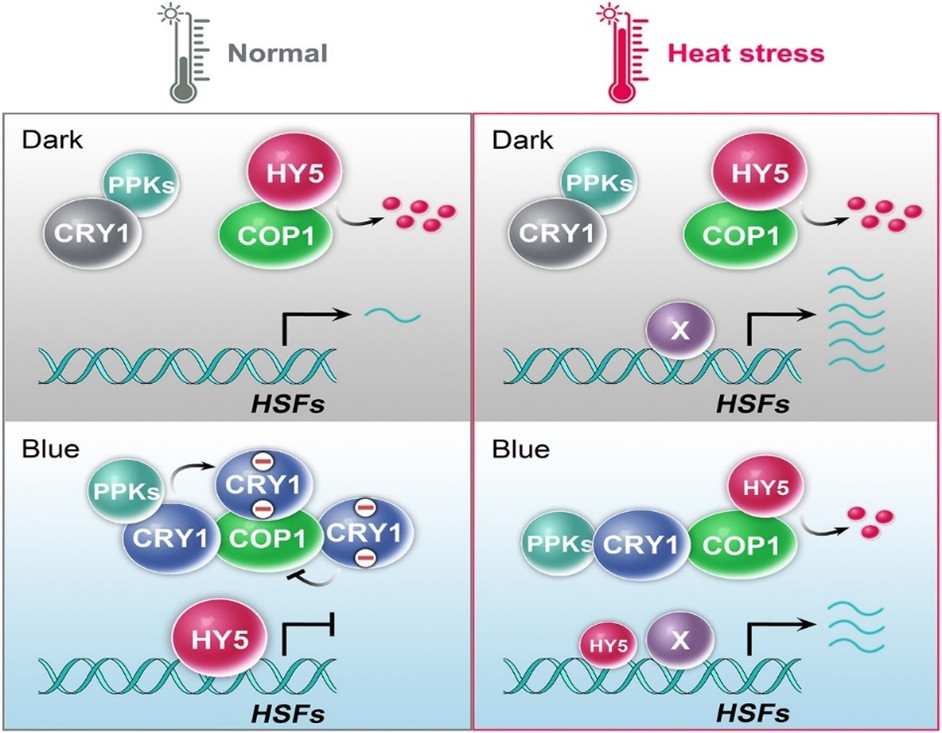 Plants use several photoreceptors to perceive light including the cryptochromes (CRYs), which are implicated in blue-light reception and coordinate developmental processes including photomorphogenesis. Here, Liu et al. shed light on how light and temperature cues simultaneously affect plants. They identified a molecular mechanism by which blue-light negatively regulates thermotolerance in Arabidopsis through the CRY1-COP1-HY5 signaling axis. At normal temperatures, CRY1 becomes phosphorylated in a photoregulatory protein kinase (PPK)-dependent manner, enhancing the interaction between CRY1 and CONSTITUTIVELY PHOTOMORPHOGENIC 1 (COP1), an E3 ubiquitin ligase. The interaction between CRY1 and COP1 inhibits COP1 activity, therefore ELONGATED HYPOCOTYL 5 (HY5) is stabilized. Accumulated HY5 proteins then bind to the promoters of the heat-shock transcription factors (HSF) genes, repressing their transcription and dampening the heat stress response under blue light. However, at high temperature, heat stress impairs the activity of PPKs, reducing CRY1 phosphorylation. Consequently, CRY1-mediated suppression of COP1 weakens, allowing it to regain its E3 ligase ability. The resulting degradation of HY5 lifts repression of HSF genes, leading to increased HSF expression compared to the response under blue light at normal temperatures. (Summary by Nathaniel Oragbon @NathanIgwe) Plant Comms. 10.1016/j.xplc.2025.101264

