

Florigen takes the heat: Flower production under fluctuating temperatures
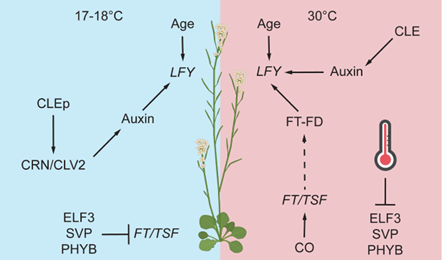 Flowers are not only a source of beauty and awe but also an important agronomical trait, since many crop yields depend on the proper timing of flowering. With increasing fluctuations in temperature, plants must finely tune the flowering process. In Arabidopsis thaliana, flower primordia formation at colder temperatures depends on CLAVATA (CLV) peptide signaling, but how flowers are maintained at warmer temperatures has remained unclear. In a new study, Smith et al. reveal that the mobile flowering signal florigen, composed of FLOWERING LOCUS T (FT) and TWIN SISTER OF FT (TSF), buffers flower production in warm environments. Using crn/clv2 mutants defective in CLV signaling, the authors found that heat-induced FT expression bypasses the requirement for CLV signaling, restoring flower primordia outgrowth. Surprisingly, this restoration does not rely on auxin biosynthesis. Instead, florigen interacts with shoot apical meristem transcriptional regulators such as FD and LEAFY to sustain flower initiation and development. Continuous florigen production after floral transition proved necessary to canalize flower formation, contrasting with florigen’s classic switch-like role in flowering time control. Together, the results show that CLV signaling and florigen act in parallel and synergistic pathways to ensure robust flower production across temperature regimes. These insights are highly relevant for future breeding efforts to create crop varieties resilient to temperature fluctuations. (Summary by Katarina Kurtović, katarinakurtovic.bsky.social) Curr. Biol. 10.1016/j.cub.2025.06.001

