

First structure of the AUX1 auxin importer resolved
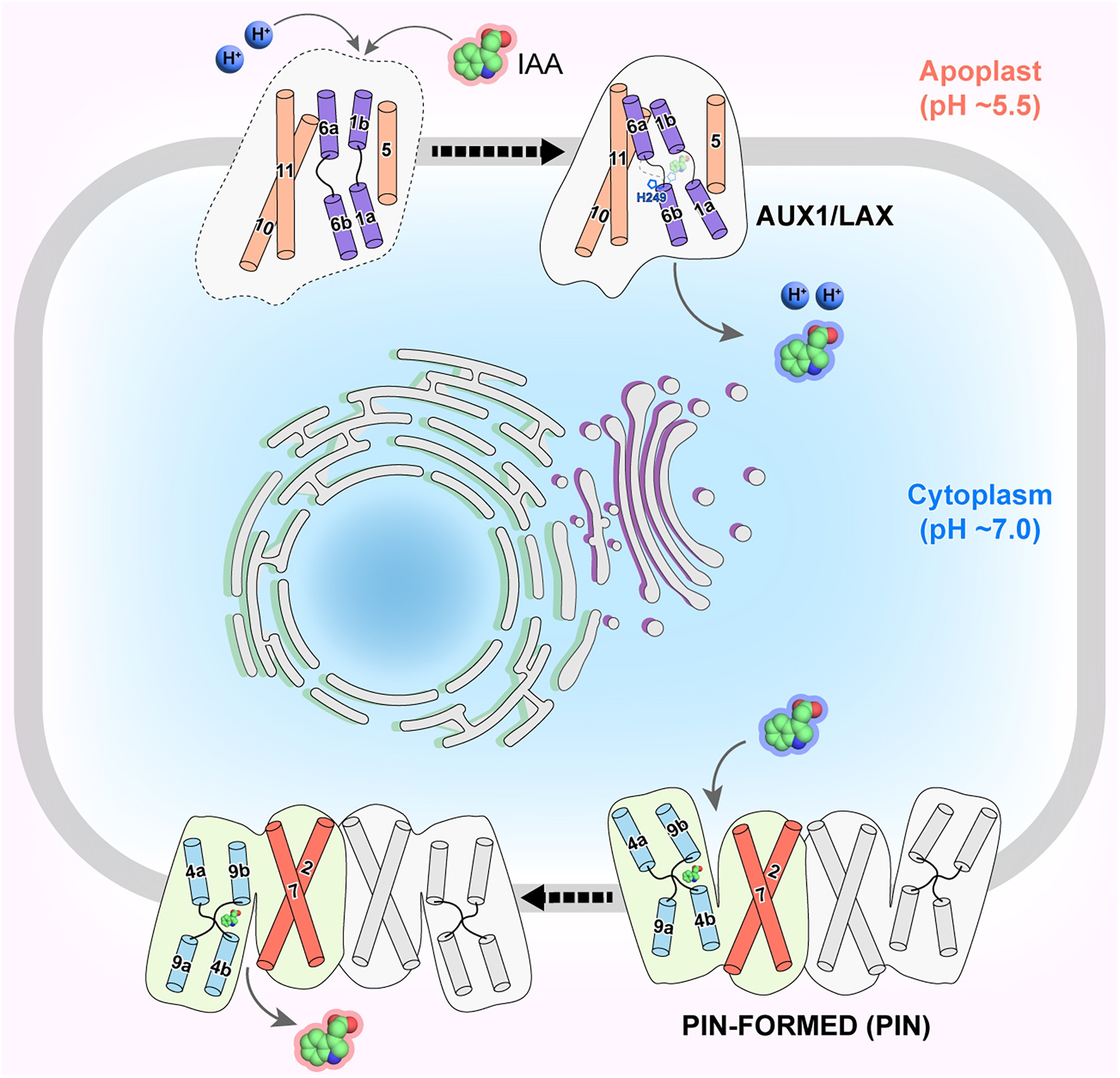 Polar auxin transport is central to plant development, relying on coordinated activity of influx carriers (AUX/LAX), efflux carriers (PINs), and ABCB transporters. While structural insights and transport mechanism of PIN proteins has been available, those of the AUX/LAX family have remained unresolved. In a recent study, Yang et al. (2025) reported the first structure of the Arabidopsis thaliana auxin importer AUX1 using cryoelectron microscopy at 3.5 Å resolution. Because AUX1 is a small 54 kDa protein, the authors fused it to a protein apocytochrome b562 from E. coli to facilitate the cryo-EM and determined structures of both the free-state and the auxin-bound state. Biochemical assays revealed that purified AUX1 has a higher auxin binding affinity compared to PIN efflux carriers, and unlike PINs, AUX1 functions as a monomer. Strikingly, the mechanism of auxin transport by AUX1 relies one key amino acid, H249. This amino acid acts as a pH-dependent switch where its protonation in the acidic apoplast stabilizes auxin binding, while deprotonation in the neutral cytoplasm weakens binding and promotes auxin release. Furthermore, the authors confirmed that the auxin influx inhibitor CHPAA competes with indole-3-acetic acid for the same binding site. This structural breakthrough completes the picture of polar auxin transport by providing molecular insight into both influx and efflux carriers, advancing our understanding of auxin action in plants. (Summary by Katarina Kurtović, katarinakurtovic.bsky.social) Cell 10.1016/j.cell.2025.04.028

