

Beyond storage: Active lipid turnover shapes seed oil metabolism
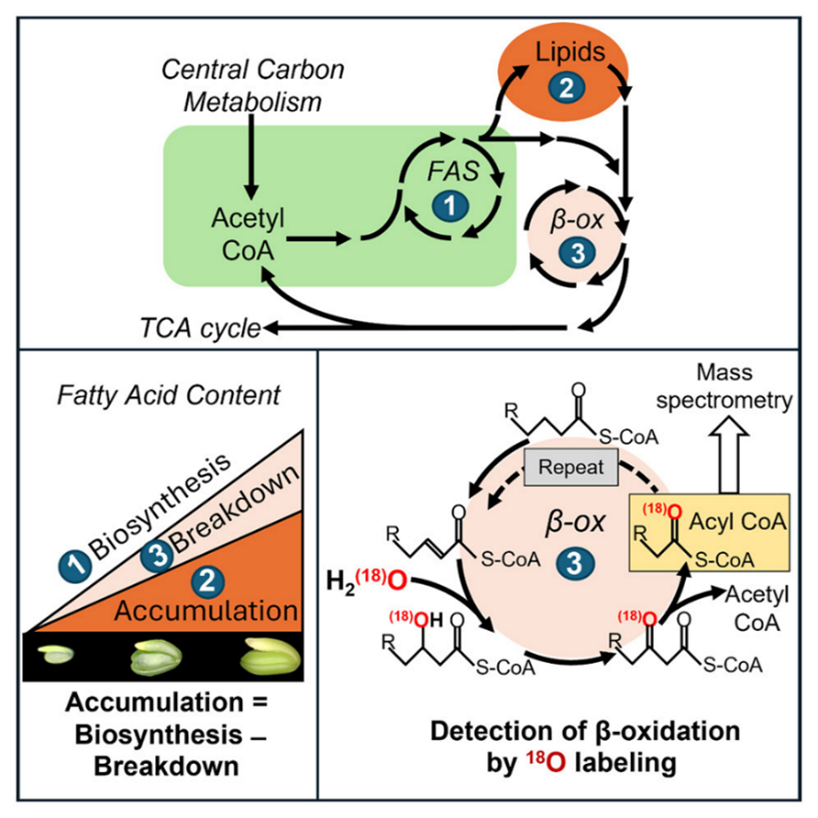 For decades, plant lipid research followed a simple narrative: seeds accumulate oil during development, then break it down after germination to fuel seedling growth. In a landmark study, Koley et al. overturn this binary view with compelling evidence that lipid metabolism is far more dynamic than previously believed. Using ¹⁸O-water isotope tracing across light/dark cycles they revealed that ‘fatty acid synthesis and degradation occur simultaneously throughout seed development’ a discovery that marks a paradigm shift in our understanding of oil accumulation. This finding reframes β-oxidation not as a dormant process waiting for germination, but as an active participant in seed maturation itself. Interestingly, attempts to enhance oil yields through genetic engineering often triggered compensatory degradation, preventing the expected gains. This suggests that living systems often prioritize balance over efficiency. The seed’s continual “make and break” cycle may appear wasteful at first glance, but it likely serves a deeper purpose: maintaining metabolic homeostasis, fine-tuning developmental signals, and preparing for environmental uncertainties. More broadly, the authors findings illustrate a fundamental principle: pressing harder on the biosynthesis “accelerator” without releasing the degradation “brake” leads only to metabolic friction. The next generation of high-oil crops may not develop from simply pushing productivity, but from aligning with the plant’s own regulatory rhythms and feedback networks. (Summary by Mohammad Aslam @asbiotech1) Cell Reports 10.1016/j.celrep.2025.115492

