

Open Sesame! Pectin tweaks plasmodesmata to control root transport
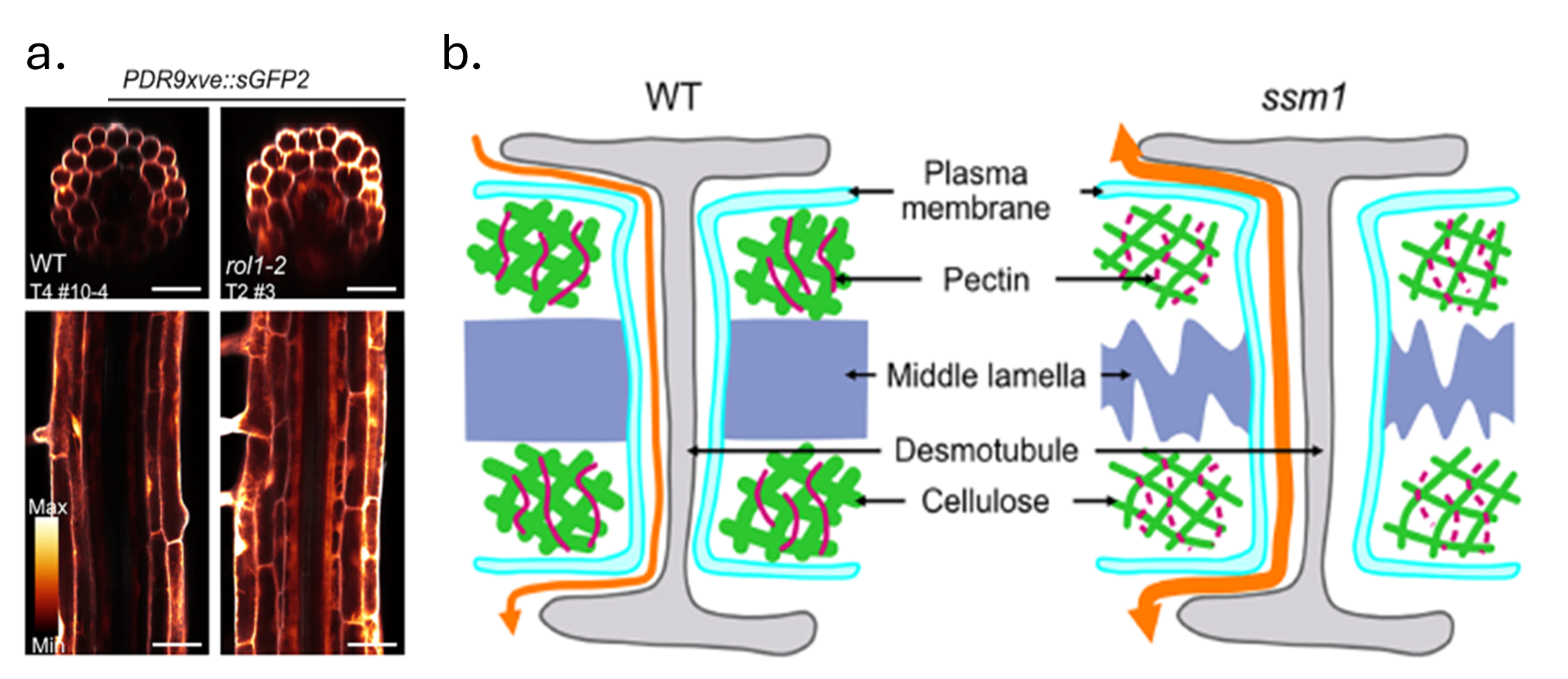 In plants, plasmodesmata provide essential symplastic connections for the movement of nutrients and signals. While their role in developing roots is well established, whether they contribute significantly to radial nutrient transport once roots are fully differentiated is still poorly understood. To address this, Jacquier et al. used tracer dyes and cell-type-specific fluorescent reporters to study symplastic transport in both differentiated and undifferentiated Arabidopsis roots. They show that plasmodesmata-mediated transport continues to occur in differentiated roots and, more importantly, undergoes a developmental switch, wherein movement is bidirectional in young roots but becomes unidirectional towards the vasculature after differentiation. Furthermore, a forward genetic screen looking for enhanced movement of GFP identified the sesame1 (ssm1) mutant (named for the story of Ali Baba and “open sesame”). Further analysis showed that ssm1 is allelic to repressor of lrx1 (rol1), which is defective in rhamnose biosynthesis and displays enlarged plasmodesmata apertures, altered cell wall architecture (pectin, cellulose and callose), and enhanced bidirectional transport. Surprisingly, despite these pronounced cell wall defects, only mild nutrient imbalances were observed in the mutant. Still, ssm1 recovered better after drought stress, hinting at adaptive benefits of altered plasmodesmata regulation. This study therefore establishes a direct link between cell wall composition, especially pectin organization, and plasmodesmata function. It also highlights a previously unrecognized developmental reprogramming of symplastic transport, with important implications for how plants balance nutrient flow and stress resilience. (Summary by Aditi Bhat @jumpy_botanist) Mol. Plant 10.1016/j.molp.2025.07.004)

