

Divide and conquer : How roots adjust division to restore shape after wounding
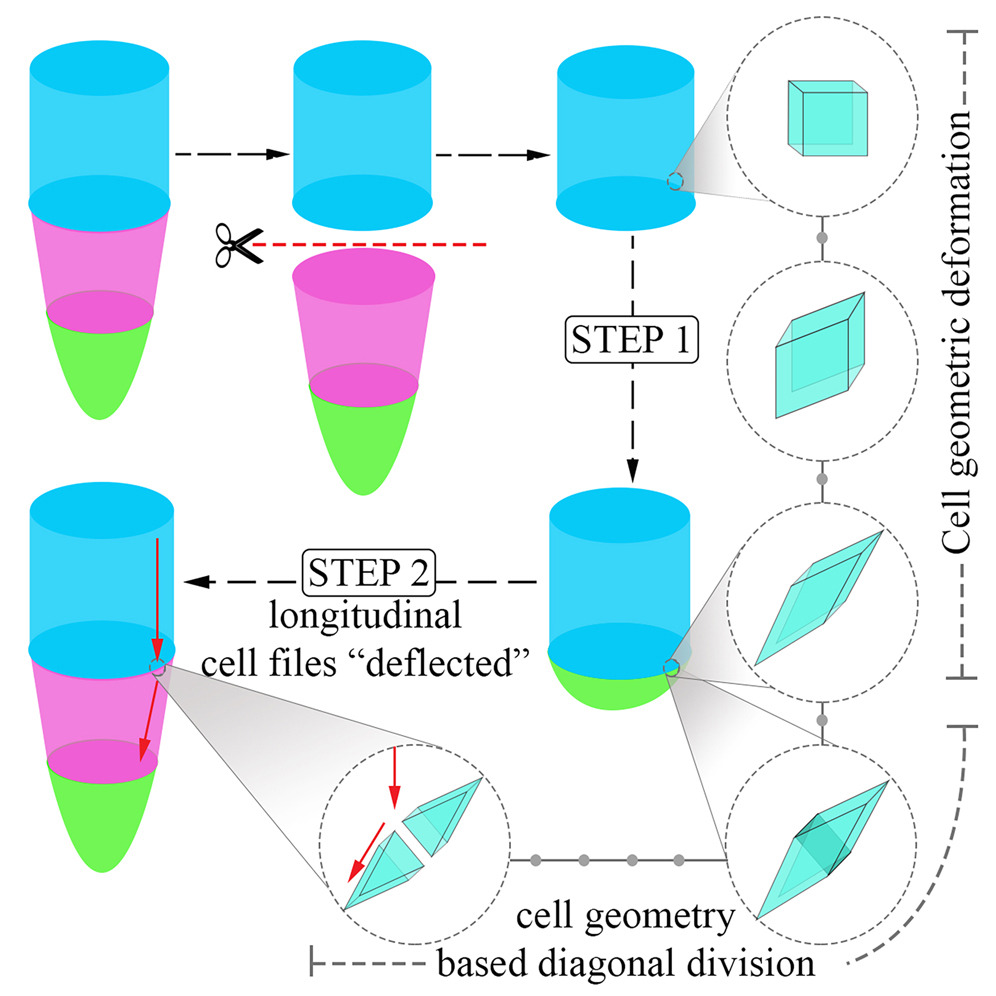 A fascinating biological phenomenon is where a root tip can be surgically removed at a distance from the stem cell niche, yet the root still robustly grows back to its initially tapered shape. Mathew et al. investigated the cellular mechanism for how root regeneration can re-develop this tapered shape following excision using a combination of computational modelling and experimental methods. Initially cells, particularly within the cortex (outer) cell file and close to the cut site, deformed from their classic rectangular shape, into rhomboidal forms (effectively lopsided and slanted). Mathew et al. explained the rhomboidal cell shape by measuring growth conflicts between cell files, showing that the inner files grow faster than the cortex and further validated this using computational simulations. Through tracking the cell division plane using pUBQ::mCIT-KA1MARK1, they found that rhomboidal cells divide diagonally, which acts to deflect the inner cell files into a tapered shape. This research is an exciting insight into the elusive world of root behaviors, as the root taper is important for the efficient foraging of the soil for its plant. (Summary by Kes Maio @kesmaio.bsky.social) Curr. Biol. 10.1016/j.cub.2025.06.072

