

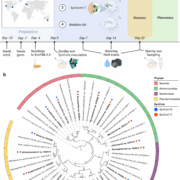
Amping up reproducibility of microbiome studies through standardized protocols and fabricated ecosystems
Plant Science Research Weekly
There is ample evidence for the impacts of plant microbiomes to plant growth and metabolism, but there are also challenges to obtaining reproducible data. In a first of its kind multi-laboratory microbiome reproducibility study, researchers from five groups across three continents used prefabricated…

Review: How to evaluate the climate-mitigation potential of plant agricultural interventions
Plant Science Research WeeklyAgriculture contributes substantially to climate change. Many agricultural interventions have been suggested as opportunities to lower this impact, through CO2 sequestration or through reducing emissions of CO2 and CH4. This review by Vickers and Zerbe lays out how to use Fermi calculations to identify…

How well do large-language models understand plant biology?
Plant Science Research WeeklyThis very interesting preprint by Fernández Burda et al. investigates how well large-language models (LLMs, such as ChatGPT) are able to correctly answer questions about plant molecular biology. The article is a huge group effort that engaged the help of over 100 plant scientists to develop MoBioPlant…

Lessons from 138 bryophyte genomes
Plant Science Research WeeklyPangenomes are amazing resources that provide glimpses into evolution that no single genome can capture. This new article by Dong et al. is a treat, as it describes the findings from a compilation of 138 bryophyte genomes, of which 123 are newly sequenced. Bryophytes are non-vascular plants (mosses,…
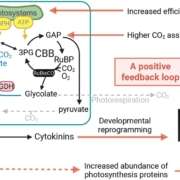
Photosynthesis reinvented: Introducing the McG Cycle for boosting plant growth and yield
Plant Science Research WeeklyPhotosynthesis is nature’s most powerful carbon capture system, fueling life on Earth and inspiring new strategies for sustainable agriculture. In plants, The Calvin–Benson–Bassham cycle generates C3 carbohydrates but is inefficient at producing the two-carbon acetyl–coenzyme A (CoA), which is…
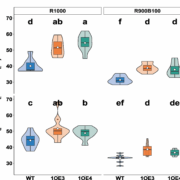
Bluer than blue: Reduced stomatal density changes red and blue light responses in wheat
Plant Science Research WeeklyStomata play an important role in balancing the amount of CO2 that goes in the plant for photosynthesis and the amount of water that goes out of the plant through transpiration. Stomatal density (SD) in plants has been studied with the goal of improving water-use efficiency (WUE) without sacrificing…
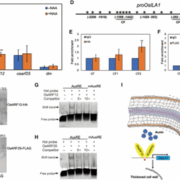
Auxin regulates rice root angle through OsILA1-driven cell wall remodeling
Plant Science Research WeeklyRoot angle is the direction and spatial orientation of roots in relation to gravity, which aids nutrient uptake and anchorage. Root angle is shaped by gravity perception, asymmetric auxin distribution, and differential growth across root zones. While auxin response factors (ARFs) are known to regulate…
Photosynthesis reinvented: Introducing the McG Cycle for boosting plant growth and yield (copy)
Plant Science Research WeeklyPhotosynthesis is nature’s most powerful carbon capture system, fueling life on Earth and inspiring new strategies for sustainable agriculture. In plants, The Calvin–Benson–Bassham cycle generates C3 carbohydrates but is inefficient at producing the two-carbon acetyl–coenzyme A (CoA), which is…
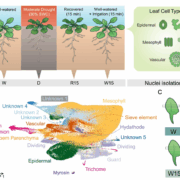
Not just reversal: The hidden power of drought recovery
Plant Science Research WeeklyWhen drought strikes, plants struggle to survive. Growth slows, flowers appear too early, fruits drop prematurely, and harvests shrink. Scientists have long tried to engineer drought tolerance plants, but boosting this often comes with a hidden cost: stunted growth even when water is plentiful. This…