
Quinine, deconstructed ✅
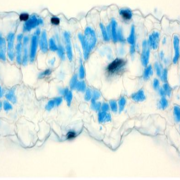
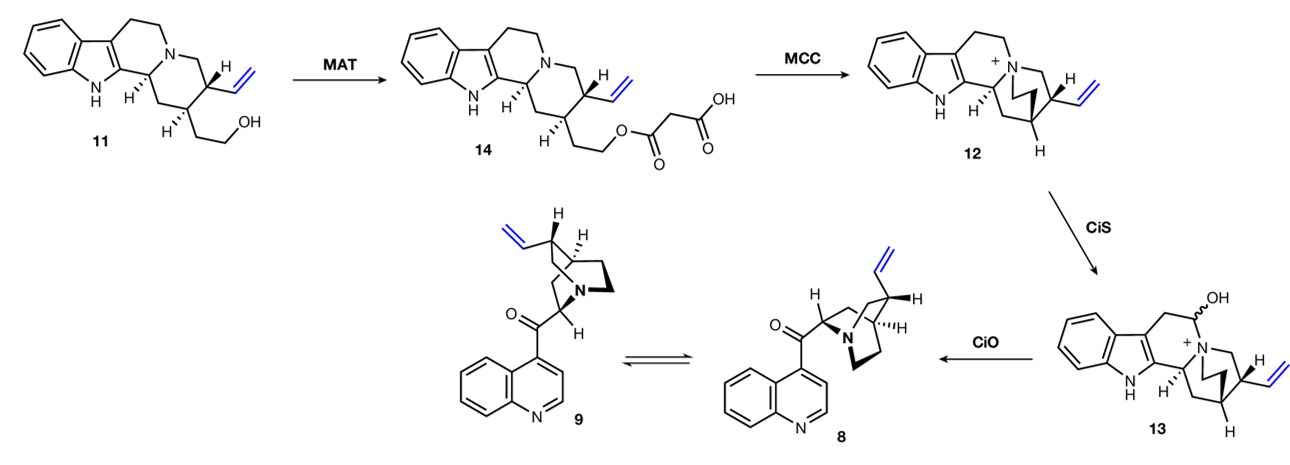 For more than two centuries, quinine from Cinchona bark has stood as one of the best-known plant-derived medicines for malaria treatment, but the enzymes that build its distinctive scaffold were unknown. Lombe et al. have now resolved the core logic of cinchona alkaloid biosynthesis in Cinchona pubescens, by combining isotope feeding, virus-induced gene silencing, single-nucleus RNA-seq, proteomics and comparative transcriptomics. A key advance is the discovery of cinchonium, a previously unknown quaternary ammonium intermediate, together with an unexpected two-enzyme strategy for forming the quinuclidine ring. The pathway uses two unrelated enzymes: one adds a malonyl group (O-malonyltransferase, MAT), and the second uses that installed malonyl group to drive ring closure (malonyl-corynantheol cyclase, MCC). Downstream, cinchonaminal synthase (CiS) converts this cyclised intermediate into cinchonaminal, and the P450 enzyme cinchonaminal oxidase (CiO) catalyses the oxidation that generates the quinoline scaffold. The identified biosynthetic genes were enriched in the same epidermal cell clusters in Cinchona leaves. Reconstitution in Nicotiana benthamiana produced natural intermediates, and when supplied with halogenated tryptamines, produced unnatural, and clinically attractive, fluorinated and chlorinated cinchona alkaloid analogues, demonstrating a potential use in medicinal chemistry. Given that the global supply of quinine depends on Cinchona plantations, this work opens future opportunities to produce cinchona alkaloids and their derivatives instead through metabolic engineering. (Summary by Charlay Wood) Nature 10.1038/s41586-026-10227-x.