

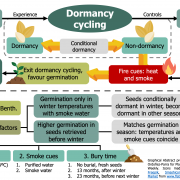
Evidence for physiological seed dormancy cycling in the woody shrub Asterolasia buxifolia and its ecological significance in fire‐prone systems ($) (Plant Biol.)
Plant Science Research WeeklyPhysiologically dormant seeds shift between dormancy (i.e., unable to germinate), conditional dormancy (i.e., germination restricted to a narrow set of conditions), and non-dormancy (i.e., germination under a wide range of conditions) in response to environmental changes. This mechanism –known as dormancy…

Plant Science Research Weekly: March 27
WWR Full PostReview. Signalling pathways underlying nitrogen-dependent changes in root system architecture: from model to crop species
Nitrogen (N) is one of the seventeen essential nutrients for a plant to complete its life cycle and is one of the most important determinants of productivity of various crops globally.…
Phosphorus sensing in Chlamydomonas by TORC1 subunit LST8
Research, The Plant Cell, The Plant Cell: In a NutshellCouso et al. developed a TOR kinase assay for Chlamydomonas and show how subunit LST8 senses phosphorus availability and modulates cell growth. Plant Cell https://doi.org/10.1105/tpc.19.00179
By I. Couso, M.E. Pérez-Pérez, M.M. Ford, E. Martínez-Force, L.M. Hicks, J.G. Umen, and J.L. Crespo.
Background:…
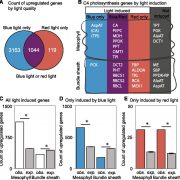
Cell-Specific Light Response in C4 Photosynthesis
Plant Physiology, Plant Physiology: On The InsideIn C4 species, the expression of photosynthesis genes is partitioned such that leaf mesophyll and bundle sheath cells accumulate different components of the photosynthetic pathway. The expression of nucleus-encoded photosynthesis genes is modulated both by photoreceptor activity and by a network of…
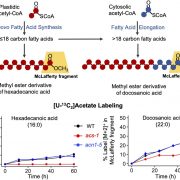
The Fate of Acetate During Hypoxia
Plant Physiology, Plant Physiology: On The InsideUnder hypoxia, Acetyl-CoA Synthetase (ACS), an enzyme that synthesizes acetyl CoA, recovers carbon that would otherwise be lost from the plant as ethanol. Plastid-localized ACS metabolizes cellular acetate and contributes to the de novo biosynthesis of fatty acids and Leu. On the other hand, a peroxisome-localized…
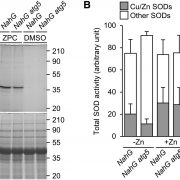
Autophagy Maintains Zinc Pools under Zinc Deficiency
Plant Physiology, Plant Physiology: On The InsideZinc (Zn) is a metallic element that is essential for all living organisms. Zn serves as a catalytic or structural cofactor in a large number of enzymes including alcohol dehydrogenase, superoxide dismutase (SOD), and regulatory proteins such as transcription factors containing Z-finger domains. Accordingly,…
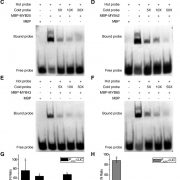
MYB Transcription Factors Regulate Secondary Metabolism
Plant Physiology, Plant Physiology: On The InsideSecondary cell walls play important roles in providing long-distance water transport, mechanical support, and plant defense. The main components of secondary cell walls are cellulose, hemicellulose, and lignin. The synthesis of lignin monomers involves the phenylpropanoid pathway, which is also shared…

The Arabidopsis GPT1 transporter is Essential in Both Plastids and Peroxisomes
Research, The Plant Cell, The Plant Cell: In a NutshellBaune et al. explore the roles of a metabolite transporter in two different locations in a single cell. Plant Cell https://doi.org/10.1105/tpc.19.00959
By Marie-Christin Baune, Hannes Lansing, Antje von Schaewen
University of Münster, Germany
Background: The oxidative pentose-phosphate…
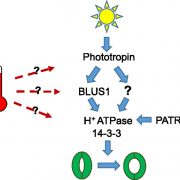
Temperature Signaling in Guard Cells
Plant Physiology, Plant Physiology: On The InsideThe elucidation of plant temperature signaling networks is confounded by the fact that commonly measured physiological outputs of temperature change (e.g., stem elongation and flowering time) can be temporally and spatially distant from the temperature perception event, requiring intercellular, intertissue,…