

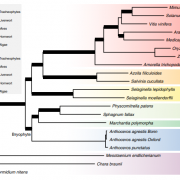
Hornwort genomes (Nature Plants)
Plant Science Research WeeklyA major update in plant genome information is taking place. Two independent groups have published genomes of hornwort species from the Anthoceros genus. Both papers arrive at similar conclusions supporting the model of a single “Setaphyta” clade, with hornworts sister to liverworts and mosses. These…

Roles for CHROMATIN REMODELING 4 in Arabidopsis floral transition (Plant Cell)
Plant Science Research WeeklyThe time at which flowers appear is critical for plant reproductive success. As such, the vegetative to reproductive growth transition is governed by several cues: environmental (photoperiod, temperature) and endogenous (gibberellins, age). Here, Sang et al. used an elegant forward-genetics approach…

The embryo sheath is an anti-adhesive structure that facilitates cotyledon emergence during germination in Arabidopsis ($) (Curr. Biol.)
Plant Science Research WeeklyThe embryo sheath is a glycoprotein structure formed during seed maturation in Arabidopsis thaliana. However, its function and its persistence after germination have been uncertain. Here, Doll et al. examined germination and seedling establishment of krs mutants deficient in the KERBEROS peptide that…

“The secret is how to die!”: CPK1 controls cell death via phosphorylation of ORE1 (Plant Cell)
Plant Science Research WeeklyCell death, like all other cellular processes, is controlled by a highly complex signaling network. A search for the targets of Arabidopsis calcium dependent protein kinase1 (CPK1) by Durian and co-workers has revealed that it phosphorylates ORESARA1 (ORE1), a master regulator of leaf senescence responses,…
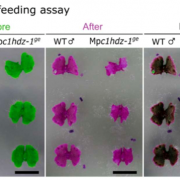
How Marchantia polymorpha avoids bug bites (bioRxiv)
Plant Science Research WeeklyPlants took hundreds of million years to evolve from aquatic to land environments. Biotic and abiotic stress adaptation contributed to the transition. In this preprint, Romani et al. elucidated functions of the transcription factor CLASS I HOMEODOMAIN LEUCINE-ZIPPER (C1HDZ) in the early land plant Marchantia…

A feedforward loop controls vascular regeneration and tissue repair through local auxin biosynthesis (Plant Cell)
Plant Science Research WeeklyPlant cells are entrapped in rigid cell walls, so morphogenesis relies on asymmetric cell division (ACD) and positional cues to regulate tissue patterning. The Arabidopsis phloem is a good system to study tissue patterning due to its relatively simple composition: sieve elements (SEs) and companion cells…
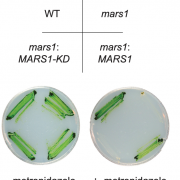
Mars1 kinase signaling in the chloroplast unfolded protein response (eLIFE)
Plant Science Research WeeklyIn stressful situations, such as high light and nutrient scarcity, the chloroplast may experience increased proteotoxicity due to a surge in damaging reactive oxygen species. In response, a signal is sent to the nucleus to increase production of many proteins, including proteases and chaperones to help…
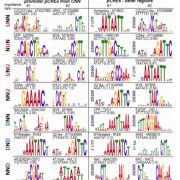
The cis-regulatory codes of response to combined heat and drought stress (bioRxiv)
Plant Science Research WeeklyAs sessile organisms, plants must not only respond to a single stress, but multiple stresses at the same time. To understand the DNA regulatory elements that mediate the transcriptional response to heat, drought and combined heat and drought stress, Azodi et al. utilized the known transcription factor…
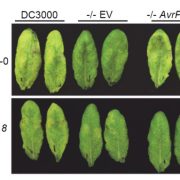
A plant kinase exploited by a bacterial effector (bioRxiv)
Plant Science Research WeeklyPathogens have evolved a suite of effector proteins that are secreted into plants and aid successful colonization. AvrPtoB is a well-conserved effector of pathogenic Pseudomonas syringae strains that targets multiple plant defense-related proteins and is required for pathogen virulence and bacterial…