When timing shapes root architecture
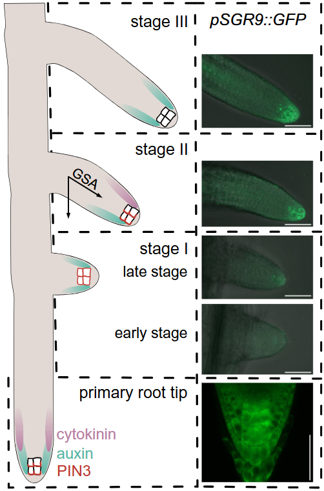 How does a plant determine the angle at which a new lateral root should grow? A recent study by Farkas et al. reveals that the answer may depend not only on how plants perceive gravity, but when they perceive it. Lateral roots initially emerge almost perpendicular to the primary root before developing a characteristic gravitropic set‑point angle (GSA), which influences how roots explore the soil for water and nutrients. The authors found that the protein SHOOT GRAVITROPISM 9 (SGR9) plays a key role during this developmental transition. Stage-specific transcriptomics revealed that SGR9 expression increases as lateral roots become gravitropically competent. Using live imaging, the researchers showed that loss of SGR9 delays amyloplast (starch granule) sedimentation in gravity-sensing columella cells. This delay reduces the polarization of the auxin transporter PIN3, resulting in weaker and less synchronized auxin redistribution. Interestingly, this does not simply slow bending, and sgr9 mutants establish a different initial GSA, while retaining the ability to respond to gravity later in development. These findings uncover a fascinating principle that timing can be as important as the signal itself. (Summary by Adrian Gonzalez Ortega‑Villaizan @adrigov98 @adrigov.bsky.social) Proc. Natl. Acad. Sci. USA10.1073/pnas.2536276123