
4D spatial transcriptomics reveals root nodules and lateral roots follow parallel developmental trajectories
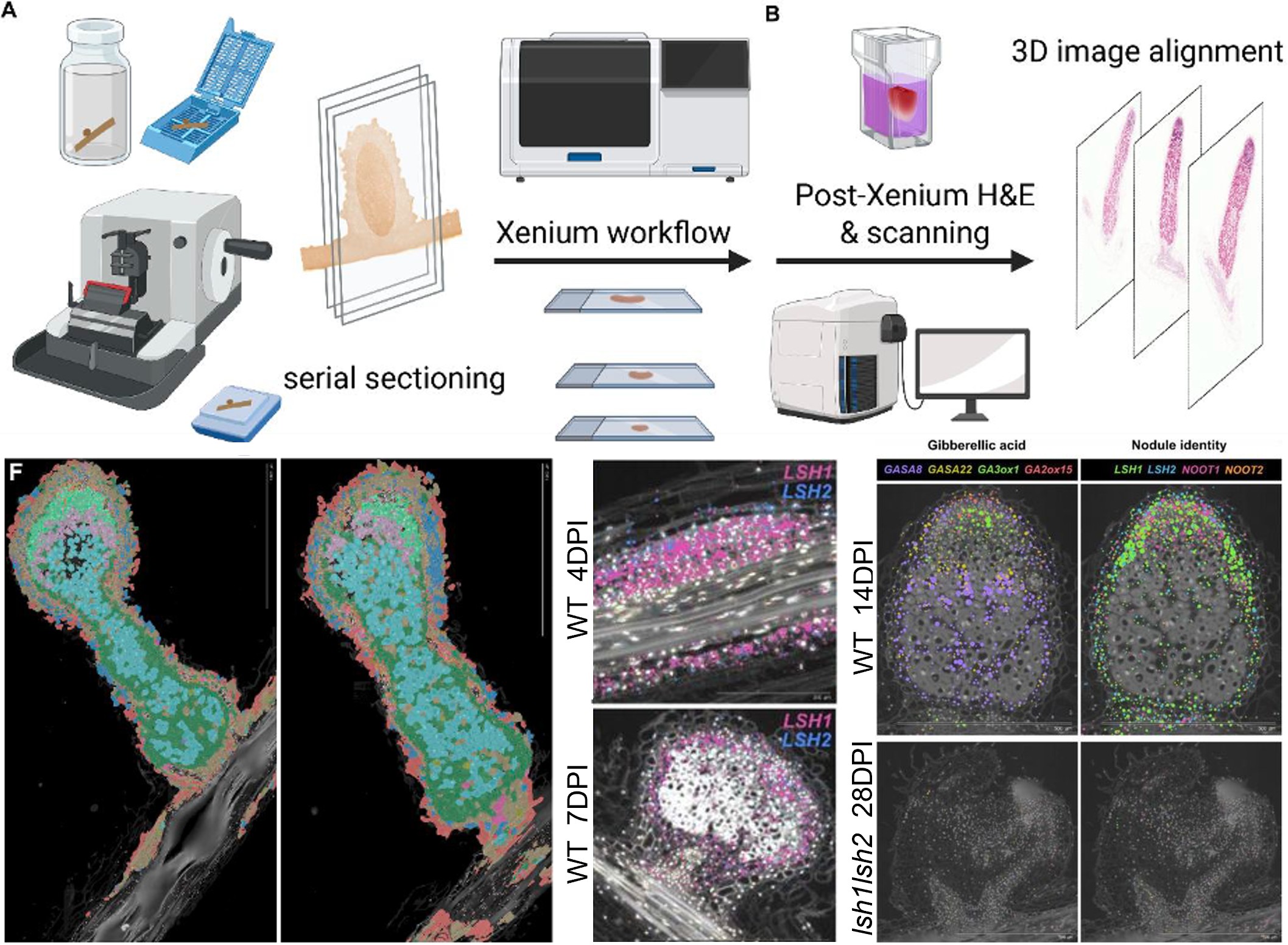 Root nodules are specialized organs that house nitrogen-fixing rhizobia bacteria. Previously, bulk tissue transcriptomics suggested that root nodules and lateral roots share most transcriptional programs and therefore may share overlapping developmental trajectory. Contrary to this model, recent work by Min-Yao Jhu and colleagues presents evidence for a parallel developmental trajectory. To generate multiple high-resolution, single-cell transcriptomic maps, the authors conducted dual-species (Medicago and Rhizobia) spatial transcriptomics using a Xenium Analyzer followed by confocal imaging. Despite overlapping transcriptomic profiles in vascular cells, a subset of distinct transcriptional patterns of nodule development genes in specialized cells differentiates the two organs. Through mutant analyses, Jhu et. al. found that the lsh1/lsh2 mutant displayed disrupted nodule cell architecture and a collapse of the hormone-related transcriptional patterning characteristic of nodule development Furthermore, loss of nodule transcriptional patterning reverts cells to a primary-root-like transcriptional state instead of a lateral-root identity, supporting the model that root nodules follow a parallel developmental trajectory instead of a shared trajectory with lateral roots. Summary by Iris Mollhoff (@iris.mollhoff) bioRxiv. https://doi.org/10.64898/2026.06.23.733685