
A 450-million-year-old signaling system shapes sperm motility
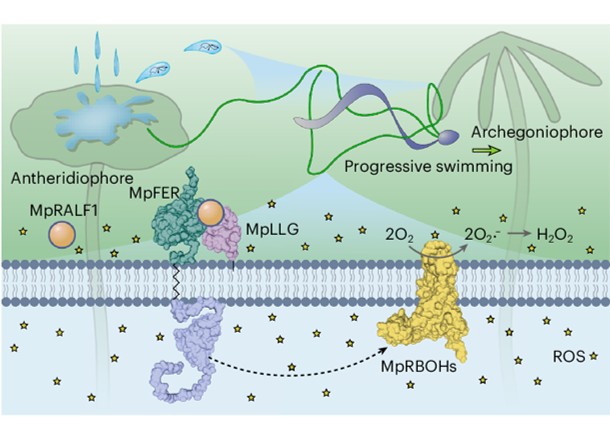 For successful fertilization, sperm must reach the egg. Most land plants deliver non-motile sperm through a pollen tube. However, the liverwort Marchantia polymorpha retains the ancestral form of fertilization, sperm that are motile and use flagella to swim towards the egg. This process offers a unique window into the evolution of reproductive signaling. A recent study by Zhang et al. in Marchantia polymorpha provides new insight into how the movement of motile sperm is controlled at the cellular and evolutionary levels. The researchers identified MpRALF1 as an important regulator whose activity is connected to ROS production, with disruption of this signaling pathway resulting in weaker and less progressive sperm movement. The ability of external MpRALF1 or H₂O₂ to restore these defects indicates that redox signaling has a direct functional role in maintaining sperm performance. The study also highlights an unexpected degree of evolutionary conservation: components of the RALF signaling network can be traced back to early land plants, and Arabidopsis RALF peptides retain partial activity in Marchantia despite their vast evolutionary separation. These findings suggest that coordination between peptide signaling and cellular redox status is an ancient reproductive strategy that has been retained and adapted across plant evolution. (Summary by Jahed Ahmed @picrophilus) Nature Plants 10.1038/s41477-026-02334-4