Beyond leaf color: YGRT shapes growth and reproduction in rice
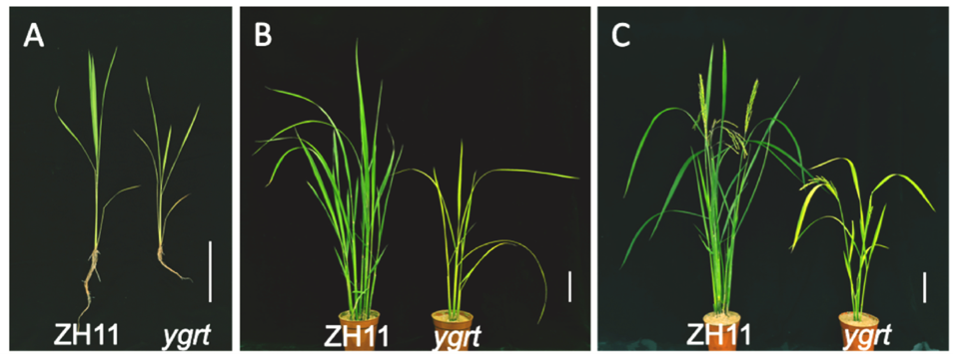 Green leaves are essential for photosynthesis and crop productivity, but the genes that maintain normal leaf development can also influence other aspects of plant growth. In this study, Wang et al. investigated a rice mutant called yellow-green leaf and reduced tillering (ygrt), which develops yellow-green leaves and produces fewer tillers throughout its life cycle. The mutant contained about half as much chlorophyll as normal rice, had poorly developed chloroplasts, and showed reduced photosynthetic activity. It was also shorter, produced smaller grains, and had lower seed production. Genetic mapping traced these defects to YGRT, a gene encoding a uridine monophosphate (UMP) kinase that localizes to chloroplasts and is involved in nucleotide metabolism. Disrupting YGRT with CRISPR reproduced the yellow-green phenotype and reduced chlorophyll levels, while restoring a functional copy of the gene returned the leaves to their normal green color. The study also uncovered a broader role for YGRT in reproduction. In the mutant, the tapetum, a tissue that supports developing pollen, did not break down at the normal time, and many pollen grains failed to mature properly. Although this gene was previously linked to chloroplast development and leaf color, these findings extend its role to tillering and reproductive development. The findings show that YGRT has a wider role in rice than previously recognized, affecting not only leaf color and photosynthesis but also plant growth and reproduction. (Summary by Deborah Ighalo) J. Plant Physiol. 10.1016/j.jplph.2026.154842