
Review: Tracing the evolution of plant cell types
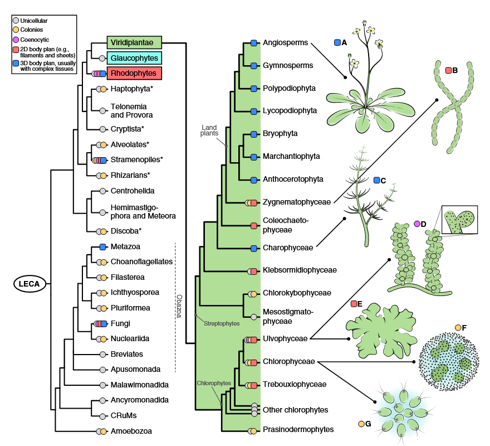 Plants. When we read this word, what comes to mind might be a rose, a tomato plant, or an oak tree. But plants belong to a green lineage that is far more diverse than what we encounter in daily life. This lineage also includes unicellular green algae. The evolution of the green lineage spans over a billion years of adaptation and expansion of genomic resources. Yet how this remarkable diversity of plant cells came to be remains an open question. A recent review by Coate et al. summarized some of these questions. Advances in single-cell research and phylogenetic information may help us unravel the mysteries behind plant cell diversity and evolution. Although plants acquired multicellularity, just as animals did, they show an astounding degree of developmental plasticity, including virtually indefinite regeneration, something uncommon in metazoan systems. Alongside this regenerative capacity, plants have several distinctive features. Their cells contain plastids, large vacuoles, and cell walls. Together, these features point to specific roles for organelle function in determining cell fates and evolution of new cell types. In addition, from a genomic perspective, plant genomes often contain transposable elements, repetitive regions, or whole-genome duplications, which may complicate and study of plant cell evolution. However, new genomic data and comparisons across phylogenetic scales can reveal how ancestral states evolved and provide insights into the origin of plant complexity across the enormous diversity of the green lineage. (Summary by Katarina Kurtović, katarinakurtovic.bsky.social) Current Biology 10.1016/j.cub.2026.04.003