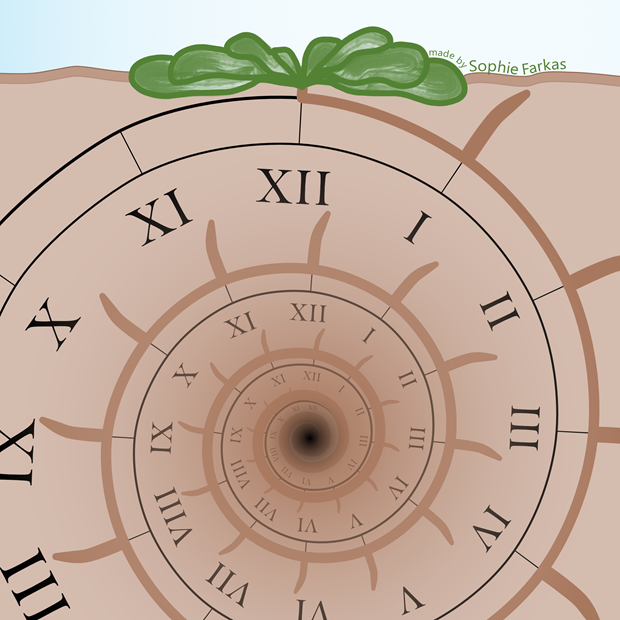
The clock may be ticking, but is it setting the rhythm?
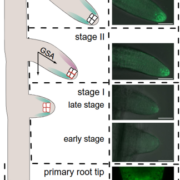
The root system architecture of dicot plants relies on lateral root spacing. Lateral roots are primed via auxin maxima in the main root that mark prebranch sites where lateral roots may later develop. A big debate in plant science is what drives this periodic auxin signaling that primes lateral rooting. Three explanations have been proposed: a cell-autonomous root clock, periodic cell death in the root cap, and a tissue-level reflux-and-growth mechanism. Kirsten ten Tusscher used a modeling approach to analyze these theories. Oscillations often involve negative feedback loops. In the auxin-AUX/IAA-ARF negative feedback loop, auxin promotes the degradation of AUX/IAA proteins, releasing ARFs from repression so they can activate auxin-responsive genes (encoding AUX/IAA proteins), and the newly produced AUX/IAAs repress ARFs again. This loop can generate cellular oscillations, which are abolished by PIN-mediated auxin export in the model. However, such oscillations could drive periodic prebranch site formation if localized in the meristematic zone, which has not been shown so far in planta. Oscillations localized in the elongation zone cannot, in the model, generate periodic prebranch-site formation because cells do not retain oscillator-phase information as they move through the zone. What then drives lateral root priming? In conclusion, more research is needed to settle this debate, and we are eager to see the upcoming results of the labs working on this topic! (Summary by Sophie Zoe Farkas @sophiezoe.bsky.social) Plant Cell 10.1093/plcell/koag213