
Reprogramming plant development: How Ustilago maydis hijacks auxin signaling to build galls
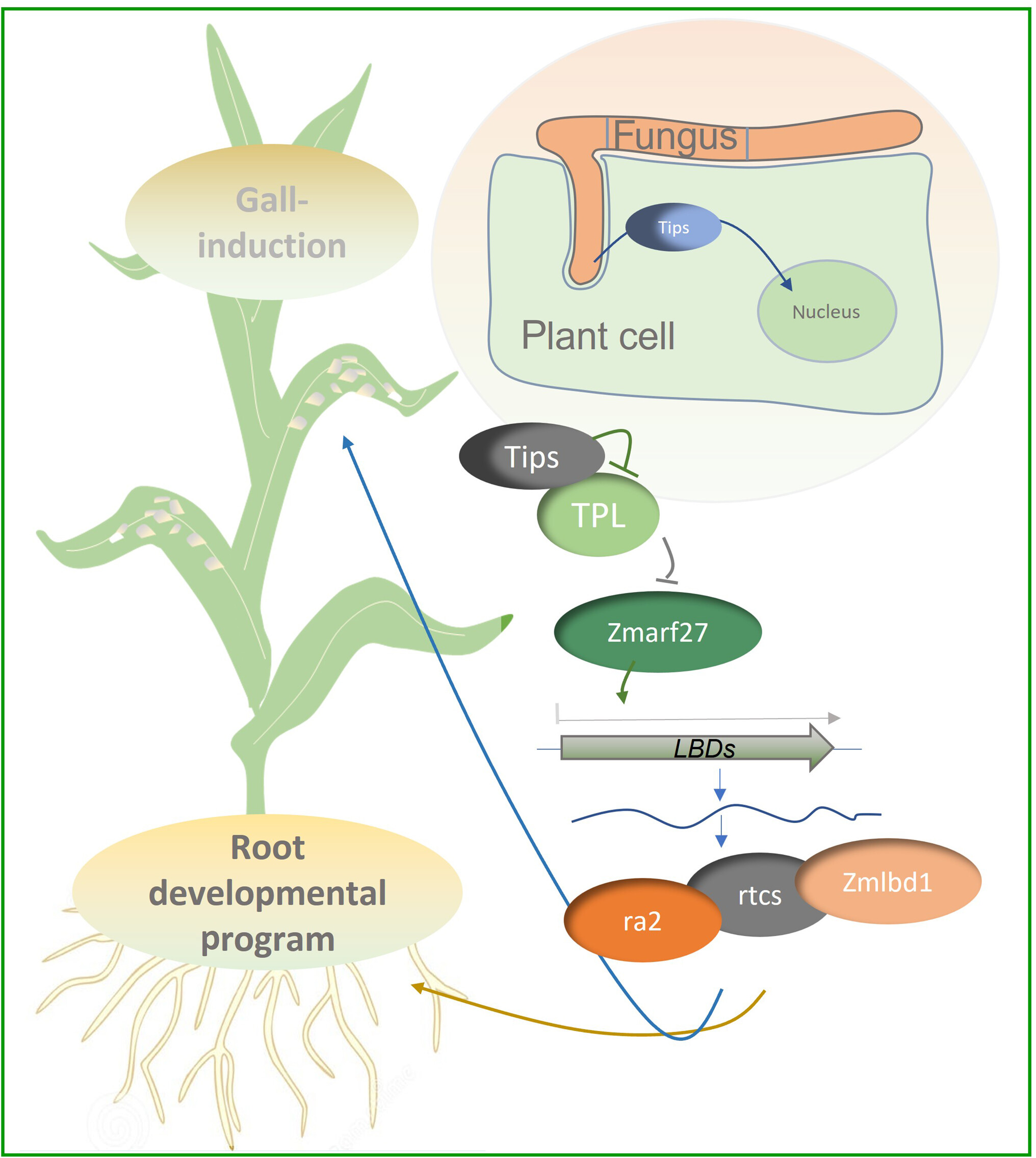 Plant pathogens often succeed not by brute force, but by subtly rewiring host developmental programs. Ustilago maydis, the basidiomycete fungus responsible for maize common smut, exemplifies this strategy by inducing tumor-like galls on aerial organs of its host. Although the U. maydis genome encodes hundreds of predicted secreted proteins, the effectors that directly drive gall formation have remained largely elusive. Previous work revealed that U. maydis infection elevates auxin levels in maize and that at least ten fungal effectors (including Tip proteins) converge on TOPLESS (TPL) transcriptional corepressors to modulate auxin signaling, a pathway essential for biotrophic growth. To dissect the downstream consequences of TPL interference, Khan and colleagues expressed individual Tip effectors in Arabidopsis. Tip induction caused chlorophyll loss, growth arrest, and alterations in root architecture. Based on their phenotypic outputs, the authors classified TPL-interacting effectors into two functional classes. Notably, class II effectors triggered hormone-independent, callus-like structures in roots that retained pluripotency and could regenerate shoots. Genetic analyses demonstrated that these phenotypes require ARF7/ARF19-mediated auxin signaling and involve transcriptional activation of LATERAL ORGAN BOUNDARIES DOMAIN (LBD) genes. Consistently, maize mutants in LBD homologs showed reduced gall formation. Together, this work reveals how fungal effectors hijack conserved auxin-TPL-ARF-LBD modules to reprogram host cell fate, opening new avenues to understand, and potentially disrupt, fungus-induced tumorigenesis in plants. (Summary by Ching Chan @ntnuchanlab @ntnuchanlab.bsky.social) New Phytologist 10.1111/nph.70843