A sister protein of the KAR/KL receptor can negatively regulate karrikin signaling in Arabidopsis
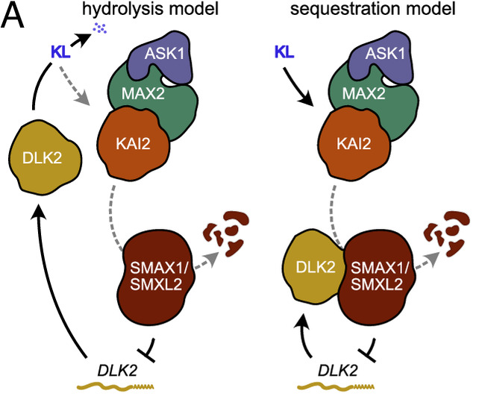 Karrikins (KARs) are a class of molecules that are hypothesized to mimic an undiscovered plant hormone KL (KAI2 Ligand). The signaling cascade triggered by KAR/KL is initiated by the α/β-hydrolase, KAI2, and can regulate several traits like germination, stress tolerance, and others. KAI2 is related to the DWARF14 (D14) receptor involved in strigolactone signaling. KAI2 and D14 have an ancient paralog D14-LIKE2 (DLK2), whose function was unknown. Li et al. found an important negative regulatory function of DLK2 in KAR/KL signaling. Using knockout approaches, the authors found that DLK2 can promote hypocotyl elongation upstream of KAI2. Analogous to another KAR/KL regulator (KUF1), the DLK2 knockout also synthetically enhances KAR/KL signaling. Transient expression of DLK2 and fluorometric assays help identify accumulation of proteins which are degraded upon KAR/KL signaling, thereby demonstrating its regulatory activity. The authors also demonstrated that DLK2 from different plant species demonstrates a similar negative feedback activity. This study provides two models for how DLK2 may regulate KR/KL signaling and provides novel insights and clues towards identifying the unknown plant hormone KL. (Summary by Atharv Ambekar) Proc. Natl. Acad. Sci. USA 10.1073/pnas.2525145123