Florigen controls its own production to fine-tune flowering
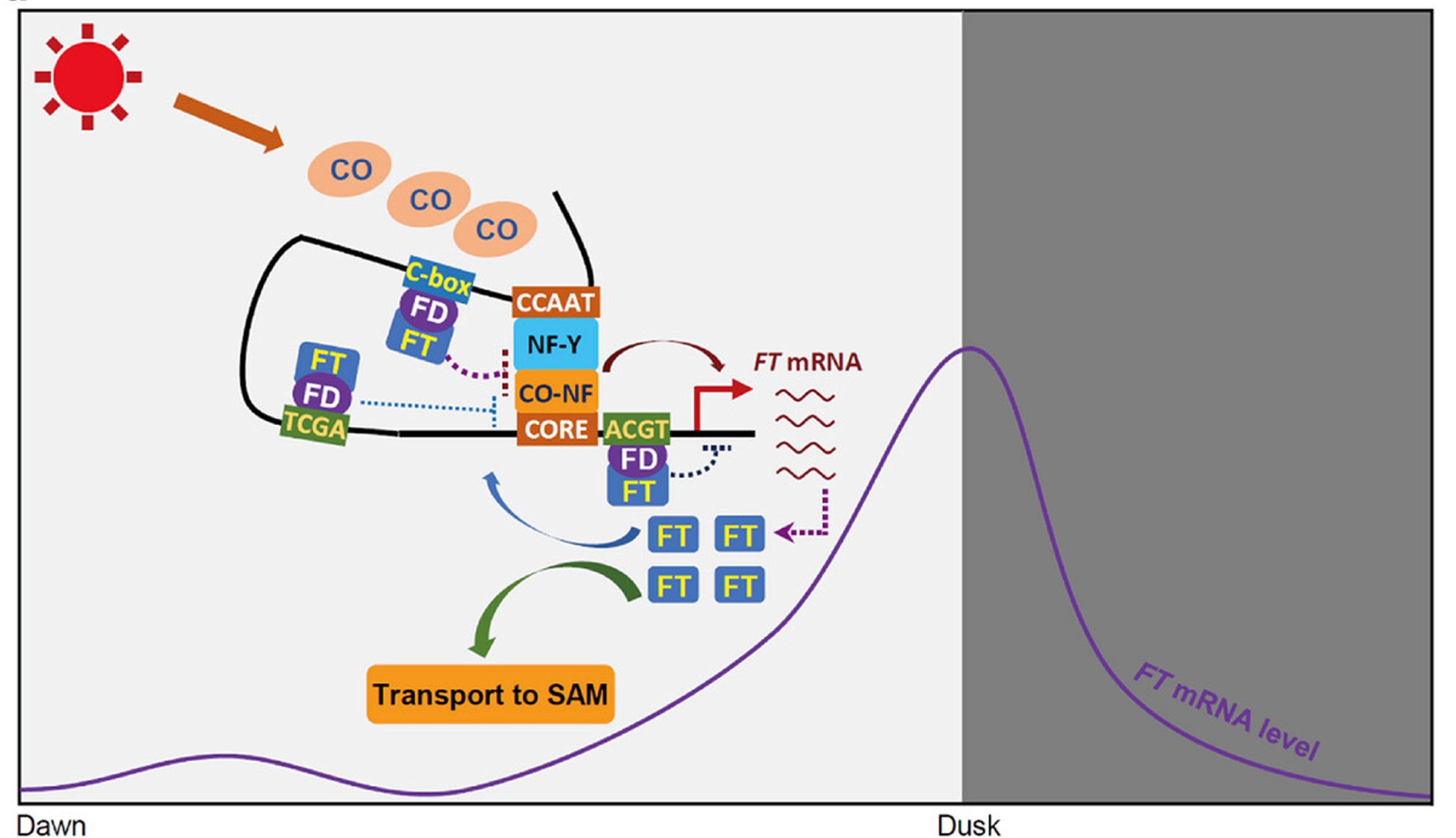 Flowering at the right time is essential for plants to balance vegetative growth and reproduction. In Arabidopsis, long days induce CONSTANS (CO) to activate the transcription of FLOWERING LOCUS T (FT) in leaves. FT protein then moves to the shoot apex, where it associates with a bZIP transcription factor FD to promote flowering. How does the plant prevent excessive FT production? Tian et al. discovered that FT is part of a negative-feedback loop that limits its own expression. Using qRT-PCR and GFP labeling, the authors detected FD expression in phloem companion cells of rosette leaves where FT is also produced. Increasing FD levels reduced FT expression and delayed flowering, suggesting that FD limits FT production in leaves. ChIP-qPCR showed that FT and FD are enriched at overlapping regions of the FT promoter. Importantly, FT enrichment was greatly reduced in the fd mutant, while FD enrichment was reduced in the ft mutant, suggesting that each protein promotes efficient association of the other with the FT promoter. The authors then showed that the FT–FD module inhibits CO-induced promoter looping, providing a mechanism for reducing CO-mediated activation of FT. Thus, FT feeds back through FD to limit its own expression and prevent excessive accumulation. In soybean, the FT-like protein GmFT4 also negatively regulates its own expression and that of the flowering-promoting genes GmFT2a and GmFT5a. This study shows that the FT–FD module not only promotes flowering at the shoot apex but also restricts FT production in leaves, helping plants fine-tune flowering time and avoid premature flowering. (Summary by Gourav Arora @gourav_arora_g) Advanced Science 10.1002/advs.202522307