
Trehalose-6-phosphate integrates metabolism and root development
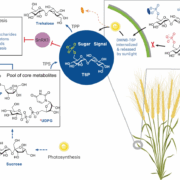
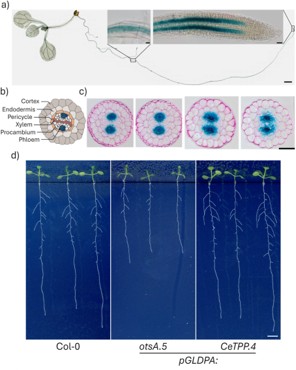 How do plants decide where to invest their resources when nutrients and energy are limited? A new study highlights trehalose-6-phosphate (Tre6P), a key sugar-status signal, as a critical coordinator. Previous work demonstrated that transgenic plants expressing modified versions of TPS1, the enzyme responsible for Tre6P synthesis, exhibited defects in primary root growth, suggesting an important role for Tre6P in root development. To dissect this function, Göbel and colleagues used a series of vascular-specific constructs to manipulate Tre6P levels through heterologous expression of trehalose phosphate synthase or phosphatase. Elevated vascular Tre6P led to smaller root systems and reduced sucrose accumulation, whereas vascular overexpression of TPP had the opposite effects. Reciprocal grafting experiments further demonstrated that shoot-derived vascular Tre6P is the primary driver of these systemic responses. Metabolomic analyses supported this conclusion, revealing substantial changes in shoot-to-root carbon and nitrogen allocation. Importantly, root-derived Tre6P also influenced root development independently of shoot signals, uncovering a second layer of regulation. Together, these findings position Tre6P as a critical coordinator linking metabolism, long-distance resource allocation, and root growth, providing new opportunities to engineer root architecture and improve resource-use efficiency in crops. (Summary by Ching Chan @ntnuchanlab @ntnuchanlab.bsky.social) Plant Cell Environ. 10.1111/pce.70599