

Antagonistic interactions between host and viral proteins regulate chloroplast stability
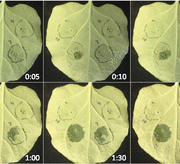
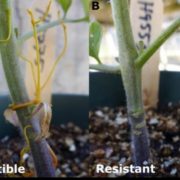
The role of the chloroplast extends far beyond hosting photosynthesis; these organelles also serve as a regulatory hub for plant immunity. As a result, many plant pathogens, such as the barley stripe mosaic virus (BSMV) have evolved strategies to circumvent this immunity and exploit the chloroplast as a site of viral replication. A recent report by Chen et al. investigates these dynamics in Nicotiana benthamiana, providing novel insights into the role of chloroplasts in plant immunity. The authors investigated PPH, a plastid-localized protein that confers broad-spectrum viral resistance, including BSMV. Transgenic plants overexpressing PPH demonstrated milder viral infection, while the inverse was true for plants with reduced PPH expression. Electron microscopy shows that PPH expression is associated with damage to the chloroplast envelope membrane, which could hamper viral replication. PPH facilitates this damage by recruiting ubiquitin ligase PUB4 to chloroplast outer-envelope proteins, such as Toc34, marking them for degradation. Upon infection, BSMV counteracts PPH-mediated chloroplast dysfunction through its viral γb protein. The γb protein interacts with PPH, resulting in the ubiquitination of PPH itself and the preservation of Toc34, promoting chloroplast stability. Interestingly, PPH appears to play a role in mitigating multiple other plant viruses as well, suggesting that PPH could be an attractive target for engineering broad-spectrum antiviral resistance. (Summary by Reed Arneson @Reed_Arneson) Plant Cell 10.1093/plcell/koag179