
Review. Decoding SCOOP signaling: evolution, recognition, and functions of a plant peptide family
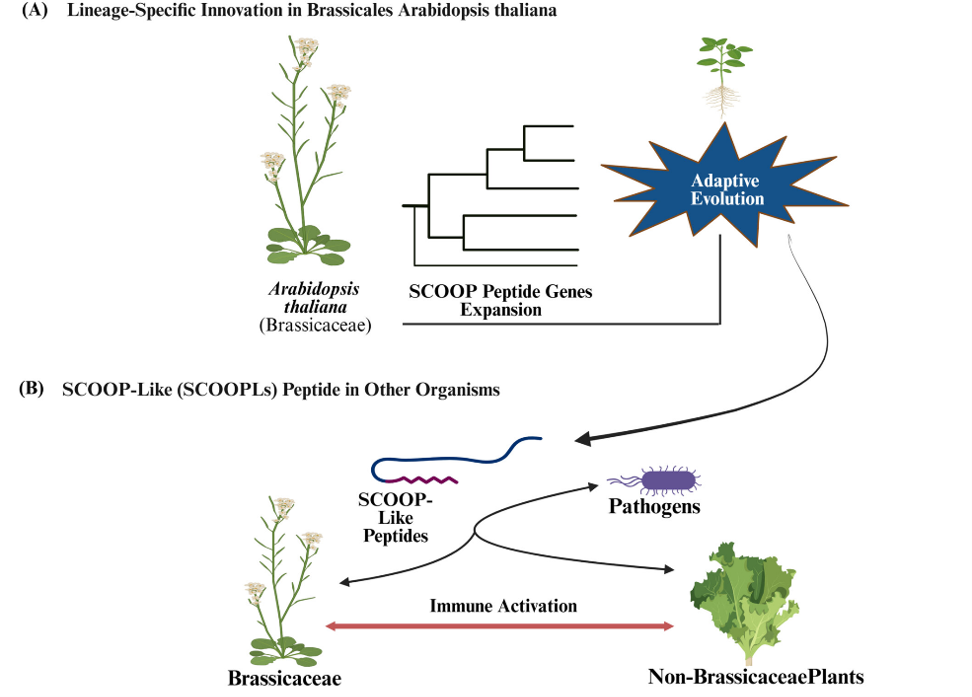 Plants continuously monitor their environment through sophisticated defense systems that recognize microbe-associated molecular patterns and activate immune responses. Among the diverse signaling molecules involved, peptides have emerged as an important molecular language that coordinates communication within and between plant cells. Despite their significance, many aspects of peptide-mediated signaling remain poorly understood. In a recent review, Roy and colleagues highlight advances in our understanding of the Serine-rich endogenous peptide (SCOOP) family. Originally thought to be unique to Brassicales, SCOOP-like peptides have been identified in microbial pathogens and non-Brassicaceae plants, revealing a more complex evolutionary history. The authors discuss the evolution, diversification, and perception of SCOOP peptides by the receptor-like kinase MIK2. The SCOOP-MIK2 module functions as a key regulator of both immune and developmental signaling and, like the classical FLS2-BAK1 receptor complex, relies on BAK1 to trigger downstream responses, including MAPK activation and reactive oxygen species production, leading to immune activation, root growth arrest, and leaf senescence. Intriguingly, pathogen-derived SCOOP-like peptides may act as molecular mimics to manipulate host signaling. Looking ahead, understanding the functional diversity of SCOOP family members and their integration with other peptide signaling networks will provide important insights into plant communication and immunity. (Summary by Ching Chan @ntnuchanlab @ntnuchanlab.bsky.social) Plant, Cell & Environment 10.1111/pce.70641