Letter. OpenCRISPR-1 in rice: when AI meets plant genome editing
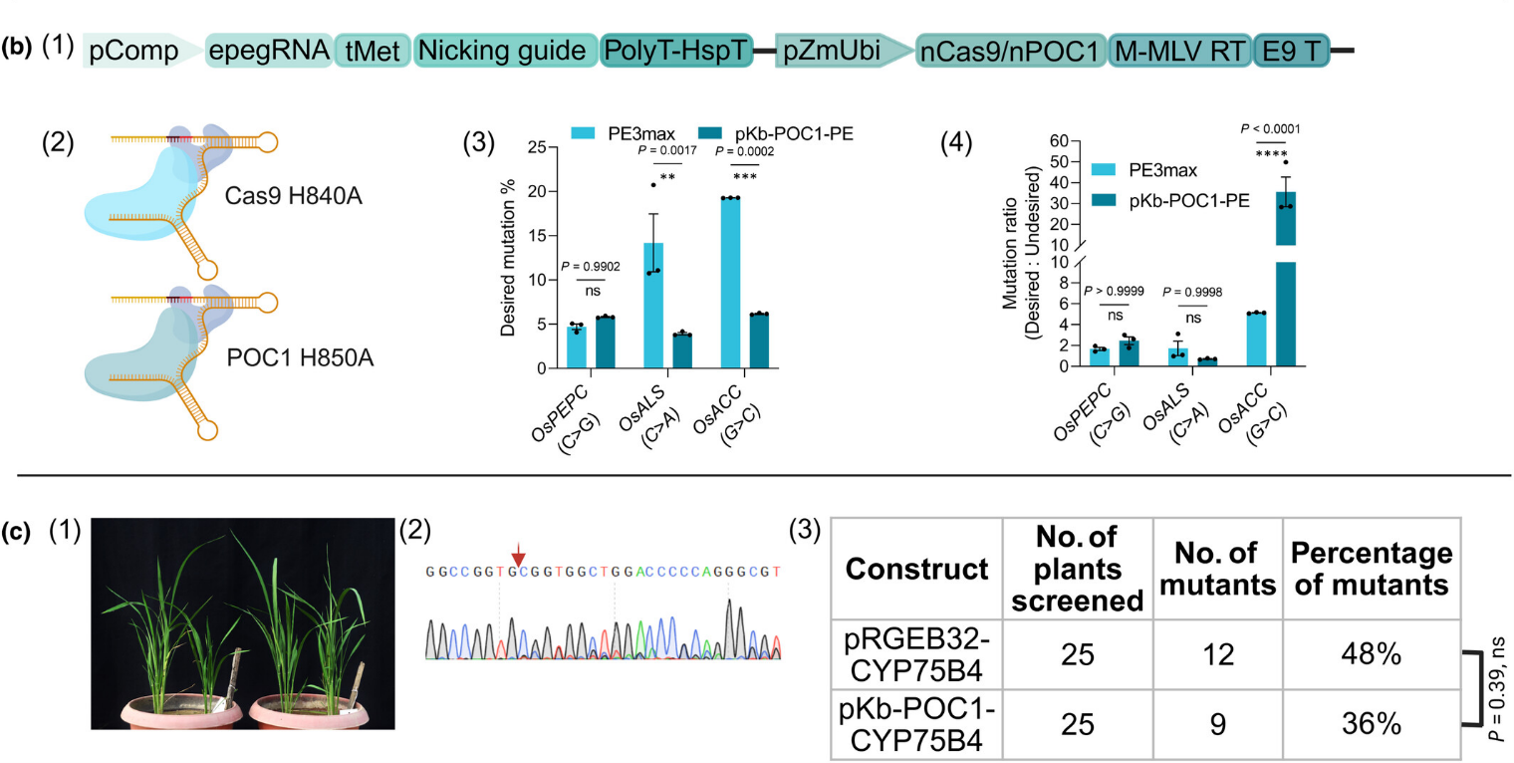 Genome editing has rapidly transformed biology, and Cas9 remains the most widely used tool for making targeted changes in DNA. Recently, a new AI-designed editor called OpenCRISPR-1 (OC1) which differs from prototypical SpCas by more than 400 amino acids has shown promise in human cells. Das and colleagues took the bold next step of testing it in rice, through a system they refer to as Plant OpenCRISPR1 (POC1). Their first experiment used rice protoplasts to create double-strand breaks at four target loci, with editing efficiencies ranging from 10.0% to 16.8%. These results were not significantly different from those of conventional SpCas9, suggesting that POC1 can perform comparably in plants. The authors then expanded the study to more precise editing modes. Base editing was used to induce specific single-base conversion, while prime editing allowed targeted sequence rewriting from an RNA template. They also assessed biallelic editing, where more than one gene is modified. In each case, POC1 could perform the edits, and its performance remained broadly comparable to that of established methods. Overall, the study shows that an AI-designed editor can function effectively in a crop species, opening the door to more flexible and potentially more powerful genome-editing tools for future plant improvement. (Summary by Ching Chan @ntnuchanlab @ntnuchanlab.bsky.social) New Phytologist 10.1111/nph.71272