
Coordinating plant growth and stress resistance via N-terminal protein acetylation
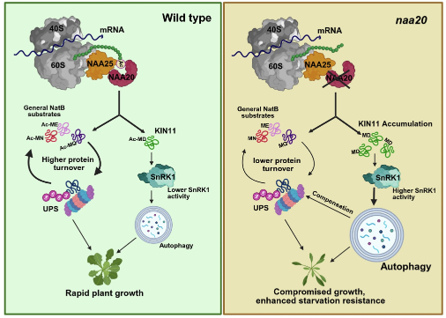 The mechanisms by which plants switch between growth and stress survival remain somewhat enigmatic. Following on from previous studies, Gong et al. revealed that the conserved N-terminal acetyltransferase B (NatB) helps regulate this balance. Arabidopsis mutants lacking the catalytic subunit of NatB, NAA20, show disrupted N-terminal acetylation of NatB substrates, and these plants exhibited slower growth but unexpectedly improved tolerance to nutrient limitation. The authors found out that NatB-mediated acetylation normally promotes the degradation of its target proteins through the ubiquitin–proteasome system (UPS). However, when this acetylation is disrupted, plants shift toward autophagy-mediated recycling. The trigger for these events in natb mutants was the loss of KIN11’s acetylation, a catalytic subunit of the autophagy-regulating energy sensor SnRK1. As a result, KIN11 became more stable and accumulated, leading to activation of stress-response signaling. This enhanced autophagy, the cellular recycling pathway activated during nutrient limitation, thereby improving the ability of plants to cope with stress. This study gives us new insight into how plants coordinate growth and stress responses through protein acetylation and protein turnover. (Summary by Fengoula Avgeri, https://x.com/AvgeriF) Nature Comms. 10.1038/s41467-026-71208-2