
Altering a nucleotide base to escape from heat
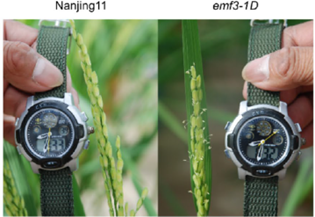
Compared to the Nanjing11 parent (left panel), its hybrid progeny carrying the emf3-1D allele (right panel) flowers earlier in the morning, as indicated by the hanging out anthers.
Crops such as rice usually flower in the late morning when the ambient temperature rises. Rice plants briefly open their flowers so the mature anthers hang out. However, heat stress can trigger abnormal anther dehiscence, flower infertility, and subsequent yield reduction. Early-morning flowering has been proposed as a strategy to escape from heat and maintain yield. A previous study in rice reported qEMF3 as the quantitative trait locus regulating the early-morning flowering trait. In the current follow-up study, Ishizaki et al. identified EMF3 as the causal gene of qEMF3. EMF3 encodes a plasma membrane protein without known functional domains specifically expressed in anthers on the flowering day. Two forms, namely EMF3 and emf3-1D, are associated with late-morning and early-morning flowering respectively. Compared to EMF3, emf3-1D has a C-to-T nucleotide substitution, resulting in a Leu (L) to Phe (F) amino acid substitution. Transcriptomic analysis of the anthers reveals the association between emf3-1D and elevated expressions of genes related to cell osmolality and cell-wall remodelling during the late-night and early morning hours. The team suggest this as a novel mechanism of anther-controlled early-morning flowering. Using two near-isogenic lines with different genetic backgrounds, they further show that emf3-1D promotes seed setting rate under heat stress. The study reports a novel heat escape mechanism regulated by emf3-1D expressed in anthers, highlighting the significance of single nucleotide polymorphism in environmental adaptations. (Summary by Yee-Shan Ku @Yee-Shan Ku) Plant Biotechnol. J. 10.1111/pbi.70653