How selective autophagy protects plants from self-damage upon infection
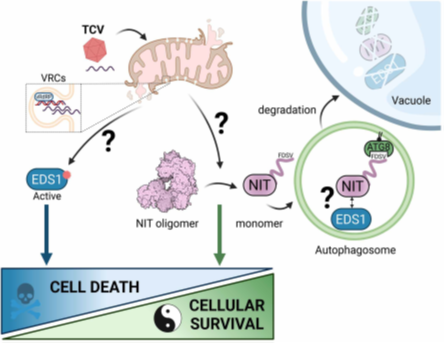 Autophagy is a conserved cellular recycling process that clears unwanted components and helps maintain balance under stress. In plants, immunity protects against invading pathogens, but how autophagy regulates this defense system has remained unclear. To address this question, Clavel and colleagues challenged a panel of autophagy-deficient Arabidopsis mutants with RNA viruses and found that all mutants exhibited more severe symptoms than wild-type. Although quantitative proteomics did not reveal obvious virus-specific cargoes, transcriptomics of the atg2 mutant showed enrichment of immune regulators, suggesting that autophagy normally helps restrain hyperactive immunity during infection. A key discovery was that EDS1, a central immune regulator that promotes defense signaling and cell death, is a critical cargo for autophagy during viral infection. By selectively removing excess EDS1, autophagy finetunes immune activation and limits self-damaging responses that would otherwise compromise plant survival. The study also suggests that certain metabolic pathways act as selective autophagy switch, linking antiviral defense to broader metabolic control in balancing plant stress resilience. (Summary by Ching Chan @ntnuchanlab @ntnuchanlab.bsky.social) Science 10.1126/science.adu9554