
Beyond AlphaFold: The Technologies Waiting to Change Plant Science
There is probably not a plant scientist on the planet who has not heard of AlphaFold (Jumper et al., 2021). Many of you reading this have likely used it. What began as DeepMind’s attempt to apply artificial intelligence to one of biology’s longest-standing problems became a breakthrough that gave researchers an unprecedented first view of many protein structures directly from the amino acid sequence.
A tool built by computer scientists, for a biological problem, changed how many biologists, including plant scientists, work.
So the question is obvious: what else is out there? What technologies are developing right now in computer science, engineering or medicine, hovering on the periphery of plant science, waiting for someone to reach across and use them?
What Can We Observe: Digital Twins and the Robots That Feed Them
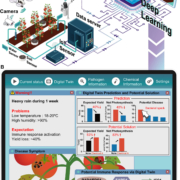
Imagine a Tamagotchi, but for a real plant. You water it, check on it, and try to keep it alive. The digital plant on your screen behaves like the real one in your greenhouse. This is the idea behind a digital twin: a virtual copy of a real plant, built from real data, that you can study, poke and simulate in ways the physical plant does not allow (Ganapathysubramanian et al., 2025).
Depending on the model, digital twins could mimic plants at the scale of whole organisms, individual cells or even single molecules. In plant science, they could help researchers test hypotheses in silico before committing to slow, expensive or destructive experiments. But a digital twin is only as good as the data feeding it. A beautifully rendered virtual plant built on poor measurements is not a breakthrough. It is just a faster way to be wrong.
That makes phenotyping one of the enabling technologies behind this future. Phenotyping is the term scientists use for measuring what a plant looks like and how it behaves: how tall it is, how green its leaves are, how fast its roots grow, how it responds to drought (Yao et al., 2018). Doing this by hand is slow, subjective and difficult to scale. Doing it with automated imaging makes phenotyping faster, more consistent and far richer.
For instance, the Smart Plate Imaging Robot (SPIRO) enables the automatic collection of time-lapse petri plate images. Using this technology, the germination of up to 2,500 seeds can be photographed at once, or the growth over time of over 190 seedlings (Ohlsson et al., 2024). On a larger scale, the high-throughput PhenoSight Phenotyping Facility at the Boyce Thompson Institute can extract 150 distinct traits using automated masking algorithms with RGB and fluorescence imaging.
These are just some examples from the emerging fields of plant phenotyping, image processing and data extraction, all of which could inform digital twin models. In the future, lower-cost phenotyping and sensing systems could help researchers and farmers detect stress earlier, intervene more precisely and reduce avoidable losses.
What If We Could Read Plant Signals in Real Time?
What if the tomato plants in your greenhouse could tell you they were thirsty around 3 a.m.? Not because plants communicate like animals, or because they are trying to speak to us in human language, but because they constantly generate measurable signals that reflect their physiological state.
They release volatile organic compounds when wounded (Bergman et al., 2025), send electrical signals across their tissues when wounded or attacked (Mousavi et al., 2013), exchange warning signals with neighbouring plants through mycorrhizal networks underground (Babikova et al., 2013), and shift their gene expression in response to changes in their environment. Even ultrasonic acoustic emissions from stressed plants have been recorded and shown to carry information about drought and injury (Khait et al., 2023).
Researchers are developing ways to measure plant signals and engineer plants as living biosensors. Engineered plants embedded with carbon nanotubes, for example, can detect nitroaromatic compounds associated with explosives and report their findings as fluorescent signals (Wong et al., 2017). Sensor technologies are also being developed to detect stress-related volatile compounds before visible symptoms appear. The question is shifting from whether these signals can be detected to whether they can be interpreted reliably enough to guide decisions.
What AI Can Help Us Read: Foundation Models for Plant Research
While robots collect physical data and sensors collect chemical and electrical signals, a third kind of technology is changing how we read what plants have already told us through their genomes.
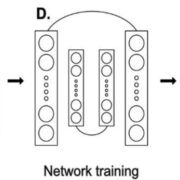
Foundation models are large AI models trained on enormous amounts of biological data. In the same way ChatGPT learned the patterns of human language, these models are learning the patterns of DNA, RNA and protein sequences.
AgroNT, for example, is trained on plant genomes and can help predict which genetic variants may affect traits such as stress responses or development (Mendoza-Revilla et al., 2024). AlphaFold 3 predicts the structures and interactions of proteins and other biomolecules (Abramson et al., 2024). For plant scientists, this means we can begin to generate stronger hypotheses about immune receptors, photosynthetic complexes, hormone signalling machinery and enzyme function before moving into the lab.
Related models are now emerging for plant genomes, RNA, regulatory sequences and protein function. The experiments still need to happen. But you go into them already knowing which doors are most worth opening.
What Happened to Everything the Last Postdoc Knew?
Picture this: you type a question into your lab’s AI: “Has anyone here successfully regenerated shoots from this explant tissue, and what conditions did they use?” — and within seconds, it surfaces a coherent, sourced answer drawn from fifteen years of notebooks, internal reports, and unpublished experiments. No digging through shelves. No hoping the right person is still in the building.
The technology behind this already exists in other industries and goes by the name Retrieval-Augmented Generation (RAG; Lewis et al., 2020). Rather than relying only on what a model was trained on, RAG lets an AI search a live database and retrieve specific information before responding. Applied to a lab, it could mean building a lab-specific AI assistant connected to everything your group has documented: every notebook entry, every protocol variation, every result that never made it into print.
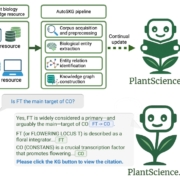
Tools like PlantScience.ai suggest that an LLM trained on plant science literature can be genuinely useful (Yu et al., 2026). But the most valuable knowledge in any lab is not in published papers. It is the transformation conditions that finally worked for a difficult species, the specific number of minutes you leave your spin column to obtain maximum DNA concentration in your miniprep, and the insight from a lab meeting three years ago that nobody thought to write down properly.
A lab-specific AI would not replace expertise. It would make collective knowledge searchable, retrievable, and permanent. The barrier is less technical and more cultural: labs would need to treat their unpublished data as an asset worth organising. Given what becomes possible when they do, that seems like an easy case to make, no?
Why Is Your Best Method Living in a File Called Final_Final?
Every bioinformatician reading this already knows Git, the version control system developers have used for decades to track every change made to a piece of code. Every edit is logged, attributed and reversible. You can branch off to try something new without touching the working version.
Now look at your protocol folder.
If your lab is like most, you will find _v2.docx, _v2OPTIMISED.docx, and inevitably _FINAL_FINAL_thisistheone.docx. The good news is that a solution already exists: protocols.io has version control, forking, and community commenting built in (Teytelman et al., 2016). The less flattering news is that many plant science labs are still not using it.
The infrastructure is there. What is missing is the culture of treating a protocol like living code: something that improves with every iteration, credits the person who improved it, and branches when a new species or tissue type requires a different approach. A protocol independently validated across four labs and annotated with species-specific caveats is a fundamentally more valuable object than a Word document on a shared drive.
If your lab has an optimised method for something — Agrobacterium transformation of a recalcitrant species, RNA extraction from lignified tissue, or anything else that took months to get right — it should not be trapped in a shared-drive folder. It should be versioned, citable and reusable. The field’s cumulative knowledge is only as good as what we are willing to share.
Where This Leaves Us
The technologies described here may look different, but they point towards the same shift: plant science is becoming more readable, searchable and connected. Digital twins, sensors, foundation models, lab-specific AI and versioned protocols all depend on how well we capture, organise and share knowledge.
That is why FAIR data practices, biocuration and versioned methods are not administrative extras (Wilkinson et al., 2016). They are the groundwork that allows promising technologies to become genuinely useful. Without that foundation, even the most sophisticated model risks floating above a messy reality.
Science has always moved fastest at the boundaries between fields, and plant science is no exception. Nobody predicted that a DeepMind project would become one of the most used tools in biology. The next tool that changes plant science may not announce itself either. The researchers who benefit most will be the ones already paying attention to what is being built next door.
This is a call to stay curious and go exploring. You never know what might open new doors in your science.
References
Abramson, J., Adler, J., Dunger, J., Evans, R., Green, T., Pritzel, A., et al. (2024). Accurate structure prediction of biomolecular interactions with AlphaFold 3. Nature, 630(8016), 493–500. https://doi.org/10.1038/s41586-024-07487-w
Babikova, Z., Gilbert, L., Bruce, T. J. A., Birkett, M., Caulfield, J. C., Woodcock, C., Pickett, J. A., & Johnson, D. (2013). Underground signals carried through common mycelial networks warn neighbouring plants of aphid attack. Ecology Letters, 16(7), 835–843. https://doi.org/10.1111/ele.12115
Bergman, M. E., Huang, X.-Q., Baudino, S., Caissard, J.-C., & Dudareva, N. (2025). Plant volatile organic compounds: Emission and perception in a changing world. Current Opinion in Plant Biology, 85, 102706. https://doi.org/10.1016/j.pbi.2025.102706
Ganapathysubramanian, B., Sarkar, S., Singh, A., & Singh, A. K. (2025). Digital twins for the plant sciences. Trends in Plant Science, 30(5), 576–577. https://doi.org/10.1016/j.tplants.2024.12.013
Jumper, J., Evans, R., Pritzel, A., Green, T., Figurnov, M., Ronneberger, O., et al. (2021). Highly accurate protein structure prediction with AlphaFold. Nature, 596(7873), 583–589. https://doi.org/10.1038/s41586-021-03819-2
Khait, I., Lewin-Epstein, O., Sharon, R., Saban, K., Goldstein, R., Anikster, Y., et al. (2023). Sounds emitted by plants under stress are airborne and informative. Cell, 186(7), 1328–1336.e10. https://doi.org/10.1016/j.cell.2023.03.009
Lewis, P., Perez, E., Piktus, A., Petroni, F., Karpukhin, V., Goyal, N., Küttler, H., Lewis, M., Yih, W., Rocktäschel, T., Riedel, S., & Kiela, D. (2020). Retrieval-augmented generation for knowledge-intensive NLP tasks. Advances in Neural Information Processing Systems, 33, 9459–9474. https://arxiv.org/abs/2005.11401
Mendoza-Revilla, J., Trop, E., Gonzalez, L., Roller, M., Dalla-Torre, H., de Almeida, B. P., et al. (2024). A foundational large language model for edible plant genomes. Communications Biology, 7(1), 835. https://doi.org/10.1038/s42003-024-06465-2
Mousavi, S. A. R., Chauvin, A., Pascaud, F., Kellenberger, S., & Farmer, E. E. (2013). GLUTAMATE RECEPTOR-LIKE genes mediate leaf-to-leaf wound signalling. Nature, 500(7463), 422–426. https://doi.org/10.1038/nature12478
Ohlsson, J. A., Leong, J. X., Elander, P. H., Ballhaus, F., Holla, S., Dauphinee, A. N., et al. (2024). SPIRO – the automated Petri plate imaging platform designed by biologists, for biologists. The Plant Journal, 118(2), 584–600. https://doi.org/10.1111/tpj.16587
Teytelman, L., Stoliartchouk, A., Kindler, L., & Hurwitz, B. L. (2016). Protocols.io: Virtual communities for protocol development and discussion. PLOS Biology, 14(8), e1002538. https://doi.org/10.1371/journal.pbio.1002538
Wilkinson, M. D., Dumontier, M., Aalbersberg, I. J. J., Appleton, G., Axton, M., Baak, A., et al. (2016). The FAIR Guiding Principles for scientific data management and stewardship. Scientific Data, 3, 160018. https://doi.org/10.1038/sdata.2016.18
Wong, M. H., Giraldo, J. P., Kwak, S.-Y., Koman, V. B., Sinclair, R., Lew, T. T. S., Bisker, G., Liu, P., & Strano, M. S. (2017). Nitroaromatic detection and infrared communication from wild-type plants using plant nanobionics. Nature Materials, 16(2), 264–272. https://doi.org/10.1038/nmat4771
Yao, J., Sun, D., Cen, H., Xu, H., Weng, H., Yuan, F., & He, Y. (2018). Phenotyping of Arabidopsis drought stress response using kinetic chlorophyll fluorescence and multicolor fluorescence imaging. Frontiers in Plant Science, 9, 603. https://doi.org/10.3389/fpls.2018.00603
Yu, H., Zhou, S., Huang, M., Ding, L., Chen, Y., Wang, Y., Ren, Y., Cheng, N., Wang, X., Liang, J., Zhang, H., Ding, Y., & Li, K. (2026). PlantScience.ai: An LLM-powered virtual scientist for plant science. Molecular Plant, 19, 1117–1123. https://doi.org/10.1016/j.molp.2026.03.010
______________________________________________
About the Authors
Charlay Wood
Charlay is a postdoctoral researcher at the University of Wisconsin–Madison and a 2026 Plantae Fellow. working on plant metabolic engineering, redirecting atmospheric CO₂ into high-value natural products including pharmaceuticals, flavour compounds, and sustainable alternatives to synthetic food dyes. Find her on LinkedIn: https://www.linkedin.com/in/charlaywood/
Ruth Nichols
Ruth is a first year Plant Biology graduate student at Cornell University and a 2026 Plantae Fellow.. In the Julkowska Lab at the Boyce Thompson Institute, she is interested in studying the Pareto front optimality of root system architectures for water transport under abiotic stress, namely microgravity and outer space conditions. She enjoys reading sci-fi, watching scary movies, camping, drawing, and drinking too much coffee.
Sonia Balyan
Sonia is a Scientist at the Indian Biological Data Centre, Faridabad, India , where she leads the development of the Indian Crop Phenome Database, Indian Animal Phenome Database, Indian Array Data Archive, BioNode, and other national-scale FAIR data resources. She is also a 2026 Plantae Fellow. Her work spans biocuration, computational biology, and plant molecular biology, with contributions to understanding microRNA-mediated stress responses in crops. She is also the founder and host of the Beyond Shodh (www.youtube.com/@beyondshodh24) podcast, serves on the Executive Committee of the International Society for Biocuration (ISB), and is an active member of AgBiodata. Find her on Bluesky: @soniabalyan.bsky.social | X: @sonia_balyanBS