
Reimagining Undergraduate Teaching and Research
Setting the stage
All of us remember sitting in front of a tutor and feeling completely inadequate for not understanding something that seemed obvious to everyone else. At the same time, many of us who have mentored students also remember encountering that one student who appeared unable to understand the material, no matter how many times it was explained.
These two experiences, feeling lost as a learner and frustrated as a teacher, exist side by side, and yet they are difficult to reconcile. While teaching, we often forget what it felt like to struggle. As students, we rarely recognize the limitations and challenges of our mentors. This contrast becomes especially important in undergraduate research environments, where mentorship, patience, and empowerment are just as essential as technical knowledge.
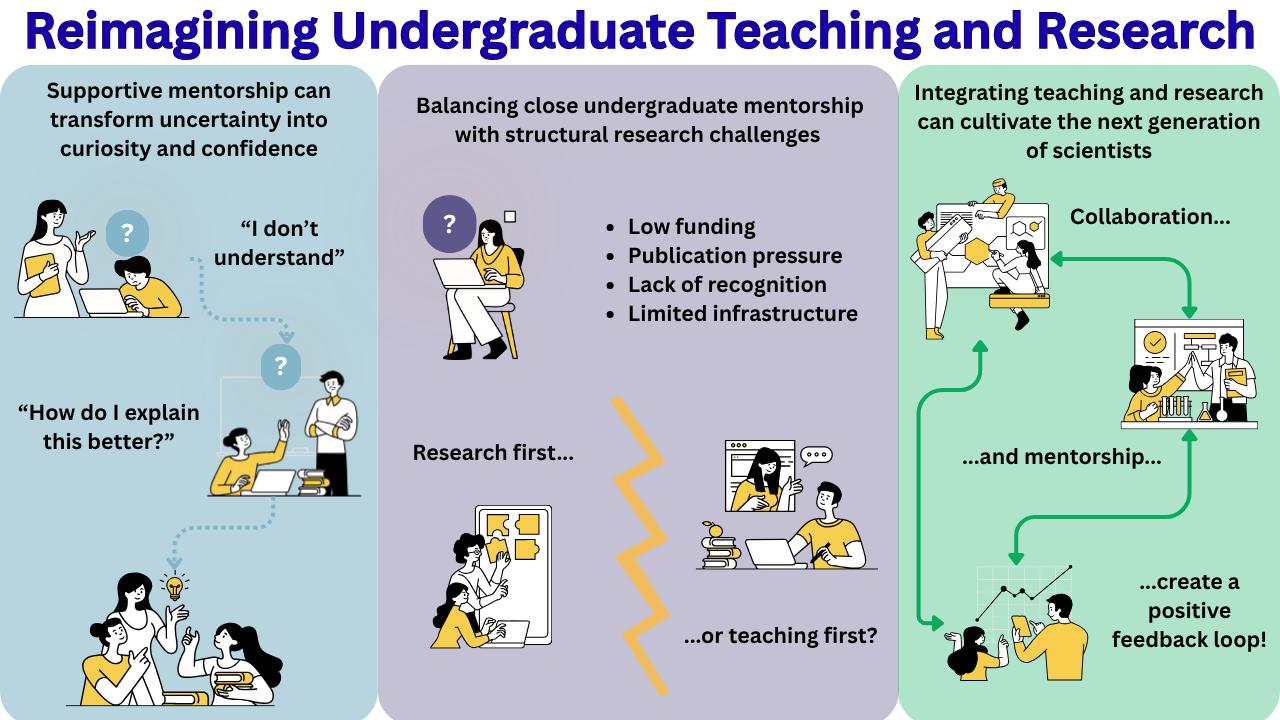
Undergraduate research is a process of learning how to think, fail, and grow within a scholarly community, which often puts high expectations throughout. Stories from undergraduate researchers reveal that many students enter research groups feeling intimidated, underprepared, or unsure of their own abilities. This is where supportive mentorship transforms those feelings into confidence and curiosity, changing the course of the student’s education.
Likewise, professors who mentor undergraduate researchers describe the experience as both demanding and deeply rewarding, requiring them to rethink how they communicate knowledge and encourage persistence. Some undergraduate research endeavours have resulted in exciting discoveries like the ‘Hasini effect’ (TED, 2018). An idea from a curious second year undergrad student without any prior research experience was welcomed by her PI, and they devoted the next few years pursuing it relentlessly (Roar Media Archive – Meet Hasini Jayatilaka, A Scientist Who Is Trying To Outsmart Cancer, 2019). This eventually led to a major breakthrough about metastasis progression in cancer and eventually moulded the naive undergrad into a well-rounded scientist, making waves in the scientific community (Jayatilaka et al., 2017).
Unveiling current teaching and research practices in a PUI
Looking at such success stories of undergraduates engaged in research, one can sense the metamorphosis that has happened in the research world, with undergrads slowly but steadily joining the force of graduate students in pushing our boundaries towards the unknown. Given the importance of correctly channeling the capabilities of undergrads, their college, most likely a primarily undergraduate institution (PUI), must be a place with potential for immense growth and learning. But what are PUIs in the first place? As the name suggests, PUIs are colleges or universities that mainly have a greater proportion of undergraduates and master’s students in their academic cohorts. Some PUIs also award doctoral degrees, but most of their focus is on teaching, with research being an auxiliary component (Ball et al., 2023). Thus, most PUIs culturally emphasize catering to undergraduates, unlike research-intensive institutions (RIIs) (Faisal, 2025).
The general responsibilities and activities of faculty in a PUI involve teaching courses, handling administrative responsibilities, serving the college community, and mentoring students. Specifically, the mentorship activities of PUI faculties are expected to be quite diverse and encompass a wide range of matters related to, as well as beyond, research. This is because they are in charge of shaping fresh minds that are malleable and are just stepping into the vast shores of academia and adult life in general. The teaching component can further be divided into classroom teaching and practical laboratory work. While the research component involves balancing research with the tight academic deadlines and a large number of courses that undergraduates are mandated to complete. Not all PUIs have the same expectations on teaching and research. Although teaching and research go hand-in-hand, somehow the academic system has evolved to compartmentalize them into distinct endeavours. For instance, some PUIs have purely teaching-based expectations from the faculty with emphasis on course development and pedagogy. While in others, the faculty could be expected to focus on teaching, with research happening at a constitutive level akin to housekeeping genes! Whereas in some institutions, professors are expected to excel in teaching obligations while producing excellent research outputs, with funds and grants being acquired (King-Smith et al., 2021). That said, it is also important to realize that such PUIs are precisely the places from which students take off into research careers and higher echelons of academia, emphasizing the importance of research experience at an undergraduate level. Going by the current practices prevalent in PUIs, the summer breaks are the major time periods for engaging students in research and for the faculty to progress in their research agendas. This is also the time when undergrads seek internships and try to find their research shelters! Some of these research experiences also serve as starting points to initiate undergraduate-focused research initiatives and internships or even give rise to undergraduate research program models that can be replicated across several institutions (Craig, 2018).
Opportunities and challenges on the way
Having looked behind the curtains of teaching and research in a PUI, it brings us naturally to the question – ‘Despite running on the two wheels of teaching and research, what leads to the difference in the research outputs from a PUI and an RII?’ Maybe looking at the benefits and challenges hidden in the PUI system can give us some answers… PUIs are generally close-knit, with students getting to directly interact with faculty. There are very few or no academic hierarchies, like post-docs or junior group leaders, for an undergrad to reach out to the PI. This is immensely powerful, since it helps the student gain firsthand exposure to research with direct mentoring from the professor. As discussed earlier, the students come with fresh minds waiting to be impacted with some great ideas, so the mentoring often has tangible outcomes with a great level of societal contribution from the faculty’s end (Faisal, 2025; King-Smith et al., 2021). This further opens the doors to applied and entrepreneurial research for faculty. They can branch out and pursue opportunities like spinning off an undergrad-led start-up or offering their support to help the student navigate diverse careers where the research skills gained can be transferred (Davis, 2026). Such opportunities can be realized very well in a PUI, as the students are highly curious and willing to take risks, although they do not have much exposure to research (Craig, 2018). But what about the resources to carry out high-quality research in a PUI? Grant providers and funding agencies often prioritize research pursuits in RIIs. Most of the scientific awards and recognitions are offered for research from RIIs with negligible consideration for undergraduate research coupled with teaching responsibilities (Ball et al., 2023). This inherently causes teaching to be viewed as a distraction or an added responsibility that slows down research rather than helping to integrate the two activities. Due to fund crunches, faculty in PUIs are often forced to mellow down or completely change their research trajectories. In some cases, this can encourage interdisciplinary research with faculty relying on one another’s expertise and resources to reach the research destination together (Ball et al., 2023; Dahlberg et al., 2021). In other cases, it leads to lowered motivation and hence reduced effectiveness of both research and teaching activities. Moreover, sometimes expectations to fulfill teaching obligations and produce high-impact research can also take a toll on the faculty’s productivity, negatively impacting both endeavours. Nevertheless, as the saying goes, ‘a challenge always arises along with its solution in close tow’. Let’s now look at a few action items and practical tips to reimagine undergraduate research and teaching in a PUI.
Practical solutions – marching towards an improved PUI ecosystem
Addressing the structural lacunae within PUIs requires systemic changes that recognize undergraduate research and teaching as interconnected rather than competing endeavours. One major step would involve shifting the priorities of funding bodies and award-granting agencies to create dedicated grants, publication incentives, and recognitions specifically for undergraduate-centred research emerging from PUIs. Special concessions, such as reduced publication fees for research generated through undergraduate participation, could further encourage faculty and students to pursue meaningful scholarly work despite limited resources.
Equally important is providing stronger institutional recognition to teaching activities, particularly “teaching by doing” (TBD) pedagogies that integrate research directly into classroom and laboratory learning. Hiring dedicated PhD-trained lecturers for undergraduate teaching at PUIs can also offer several academic, institutional, and student-centered benefits. Unlike principal investigators at PUIs who must divide their attention between research, grants, administration and teaching, dedicated “PhD-trained” teaching faculty can invest more time and energy into pedagogy, curriculum design, and student mentorship. Since these educators are trained researchers themselves, they can integrate current scientific thinking and critical analysis into the classroom without the constant pressure of maintaining high-volume research output. This often leads to improved classroom engagement, more accessible teaching styles, and stronger learning for undergraduates, particularly for students transitioning into research for the first time. Such positions could also help reduce faculty burnout among research-active professors, allowing them to focus more effectively on supervising laboratories and securing funding while ensuring that undergraduate teaching quality does not suffer. Additionally, creating respected teaching-focused career pathways for PhD graduates would encourage more academically trained individuals to pursue pedagogy as a profession, thereby strengthening the long-term teaching ecosystem within PUIs and enabling an academic environment where both teaching and research receive the attention and expertise they individually require.
Since undergraduate research in PUIs is often restricted to summer breaks, institutions could establish year-round undergraduate-focused programs such as research workshops, immersive semester-long projects, skill-development boot camps, and structured mentorship initiatives that sustain engagement beyond short internship windows. Existing international undergraduate research models and exchange programs, such as DAAD RISE and MITACS, demonstrate how early research exposure can successfully bridge teaching and innovation. Furthermore, formal collaborations and MOUs between PUIs and research-intensive institutions (RIIs) could create mutually beneficial ecosystems where undergraduates from PUIs gain access to advanced research infrastructure and exposure, while graduate students and postdoctoral researchers from RIIs acquire valuable mentorship and teaching experience. Collectively, such reforms could help transform PUIs into spaces where research, teaching, and mentorship operate synergistically to nurture the next generation of scholars.
References
Ball, N. D., Gomez, M. A., Rempel, B. P., Farkas, E. R., Makal, T. E., Shields, G. C., Parish, C. A., Tresca, B. W., & McGinitie, E. G. (2023). Conducting research at primarily undergraduate institutions. Cell Reports Physical Science, 4(2), 101255. https://doi.org/10.1016/j.xcrp.2023.101255
Craig, P. A. (2018). Lessons from my undergraduate research students. The Journal of Biological Chemistry, 293(27), 10447–10452. https://doi.org/10.1074/jbc.RA118.003722
Dahlberg, C. (Lina) L., King-Smith, C., & Riggs, B. (2021). Building a laboratory at a Primarily Undergraduate Institution (PUI). BMC Proceedings, 15(2), 2. https://doi.org/10.1186/s12919-021-00208-5
Davis, E. (2026, May 2). The empowerment of chemistry: Guy’s impact. The Northerner. https://www.thenortherner.com/arts-and-life/2025/02/02/the-empowerment-of-chemistry-guys-impact/
Faisal, M. (2025). Undergraduate Research at Primarily Undergraduate Institutions: Current State and Dilemmas. ACS Omega, 10(45), 53629–53632. https://doi.org/10.1021/acsomega.5c08717
Jayatilaka, H., Tyle, P., Chen, J. J., Kwak, M., Ju, J., Kim, H. J., Lee, J. S. H., Wu, P.-H., Gilkes, D. M., Fan, R., & Wirtz, D. (2017). Synergistic IL-6 and IL-8 paracrine signalling pathway infers a strategy to inhibit tumour cell migration. Nature Communications, 8(1), 15584. https://doi.org/10.1038/ncomms15584
King-Smith, C., Lund Dahlberg, C. (Lina), & Riggs, B. (2021). Obtaining a faculty position at a primarily undergraduate institution (PUI). BMC Proceedings, 15(Suppl 2), 3. https://doi.org/10.1186/s12919-021-00207-6
Roar Media Archive—Meet Hasini Jayatilaka, A Scientist Who Is Trying To Outsmart Cancer. (2019, January 2). https://archive.roar.media/english/life/in-the-know/meet-hasini-jayatilaka-a-scientist-who-is-trying-to-outsmart-cancer
TED (Director). (2018, August 30). How cancer cells communicate—And how we can slow them down | Hasini Jayatilaka [Video recording]. https://www.youtube.com/watch?v=1fZ915L1w7I
About the authors
Shakunthala Natarajan
Shakunthala is a second-year PhD student at the Institute for Cellular and Molecular Botany, University of Bonn and a 2026 Plantae Fellow. Her research revolves around investigating plant gene duplications using comparative genomics and transcriptomics. She develops computational tools to explore the world of plants. Outside the lab she wears the hats of a science communicator and a musician. Find her on X: @Shak_Nat | Bluesky: @shakunthalan.bsky.social
Alessandra Lombardi
Ale is a passionate plant scientist who likes to dive into the interplay between science, art, and communication and a 2026 Plantae Fellow. In their third year of their PhD in Uppsala, Sweden, they are studying evolutionary dynamics in plant speciation. Their research focuses on Capsella species as a model for the evolution of selfing.
Rini Rahiman
Rini is currently a postdoctoral fellow at Khalifa University and a 2026 Plantae Fellow. Prior to this she worked for three years as a research fellow at the National University of Singapore. Her research focuses on how environmental factors, such as light and temperature, influence the formation and patterning of stomata on the leaf epidermis. At her core, she is a passionate molecular biologist who also deeply enjoys teaching and sharing knowledge! Find her on X: @rini_rahiman