
TaMYB-D7 alleles mediate leaf pigmentation in response to nutrient status in wheat
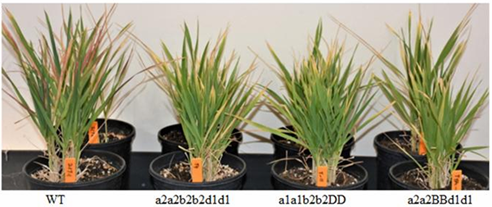 Nitrogen and phosphorus are essential macronutrients for wheat (Triticum aestivum L.) growth and development, and phosphorus deficiency is often associated with purple pigmentation in leaves due to anthocyanin accumulation. For farmers and growers, this pigmentation can be read as a sign of phosphorus deficiency. A recent study by Zhang et al. found that contrasting leaf colors in two wheat cultivars grown under low phosphorus and nitrogen conditions were due to a single nucleotide change in the TaMYB-D7 gene, resulting in an amino acid substitution. Cultivars carrying the TaMYB-D7b allele (Gly50) displayed a clear purple pigmentation response, whereas those harboring the TaMYB-D7a allele (Ser50) remained green.The researchers validated the role of TaMYB-D7 in regulating the purple phenotype by disrupting the three homeologous genes in the responsive cultivar. The edited plants did not accumulate purple pigments throughout their life cycle and showed reduced expression of chalcone synthase 2-like (TaCHSL2), a gene involved in purple pigment biosynthesis. Ultimately, this work has practical implications for breeding, highlighting the need to consider allelic differences in TaMYB-D7 to ensure that a green phenotype is not mistaken for nutritional sufficiency. (Summary by Flavia Darqui @flavia-darqui.bsky.social) Plant Physiology 10.1093/plphys/kiaf224