
Membrane-associated proteins perceive and transduce early heat stress signals
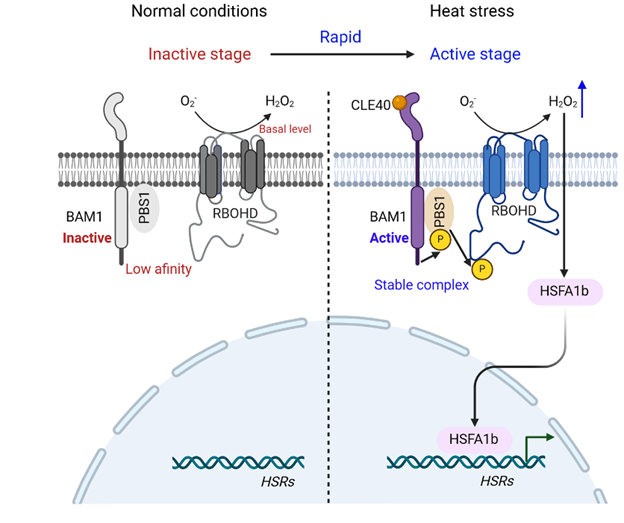 Elucidating the pathways in which plants can recognize and respond to heat stress is a key step in developing more resilient plants and crops. Work by Li et al. provides a more in-depth understanding of the early factors in heat stress-responsive (HSR) gene expression in Arabidopsis. They first identified BAM1 and PBS1, two Receptor-Like Kinases (RLK) associated with the plasma membrane. Through co-immunoprecipitation and bimolecular fluorescence complementation assays, they show that these proteins have limited interactions under standard temperatures but begin to interact quickly under high heat. The mechanism associated with the heat-induced interactions of these RLKs remains to be investigated, but analysis of transgenic plants showed that the peptide CLE40 increases BAM1 activity and promotes BAM1-PBS1 association. Regardless of the exact upstream factors, the BAM1-PBS1 complex produces phosphorylated PBS1 proteins. After phosphorylation, PBS1 then associates with the H2O2-producing protein RBOHD, enhancing RBOHD activity. This increases H2O2 levels within cells, activating the transcription factor HSFA1b by increasing protein stability and nuclear localization. RNA-seq data demonstrates that over 1,200 genes differentially expressed under heat stress occur through the BAM1-PBS1-RBOHD network, thus showing how early recognition of heat stress can remodel gene expression. This work provides a novel and robust understanding of plant thermotolerance, providing further evidence for a link between plasma membrane dynamics and heat-stress signaling. (Summary by Reed Arneson @Reed_Arneson) Molecular Plant 10.1016/j.molp.2025.10.021