Pollination before flowers: Infrared as ancient pollination cue
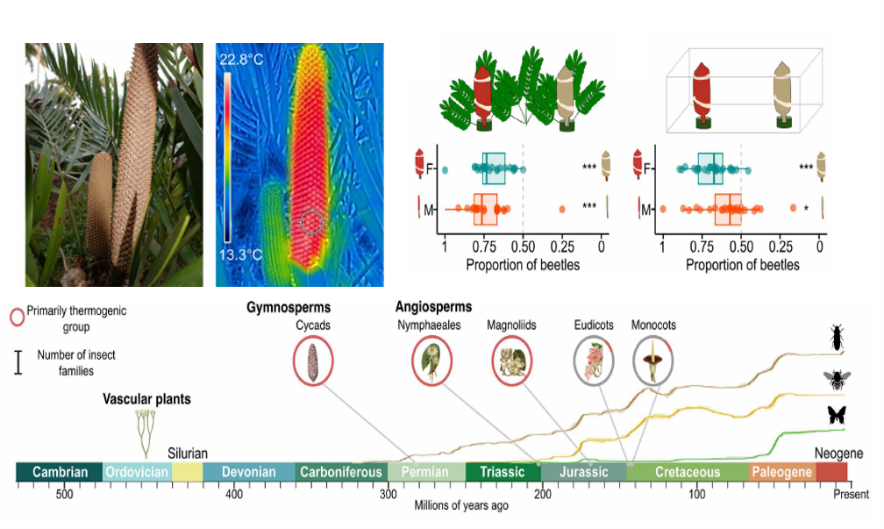 When we talk of pollination, we often imagine colorful flowers and scents that attract insects to the flowers. However, flowers are a hallmark of angiosperms. How cone-bearing gymnosperms attract their pollinators has been a long-standing question. In a recent study, Valencia-Montoya et al. investigated how cycads, one of the oldest living lineages of seed plants, are pollinated by insects (beetles). They found that heat, in the form of infrared radiations (IR), acts as an ancient pollination signal. Using thermal imaging, the authors showed that heat production in the cones is restricted to the sporophylls (reproductive organs), which are enriched in mitochondria and starch. This thermogenesis is the effect of upregulation of AOX1 in mitochondrial electron transport, which dissipates energy in the form of heat. Interestingly, cone heating follows a circadian rhythm, creating a thermal-based “push–pull” pollination system: males cones heat first to attract beetles for pollen collection, followed by thermogenesis in female cones to facilitate pollen transfer. Using 3D-printed cone models, the authors confirmed that beetles preferred models with higher temperature, and that touching the cones was not necessary. Scanning electron microscope further showed beetles antenna tips perceive IR signals via thermosensitive sensilla containing abundant neurons that respond selectively to warming. Removal of the antennae tip abolished responses to IR without affecting odor responses. A thermosensitive ion channel, TRPA1(B) expressed in antennal neurons was identified as key mediator of thermal sensing. Taken together, these findings suggest that IR signals predate colorful floral displays during pollination evolution. (Summary by Priyanka Babuta) Science 10.1126/science.adz1728