
A shape-shifting plant receptor expands the landscape of small-molecule sensing
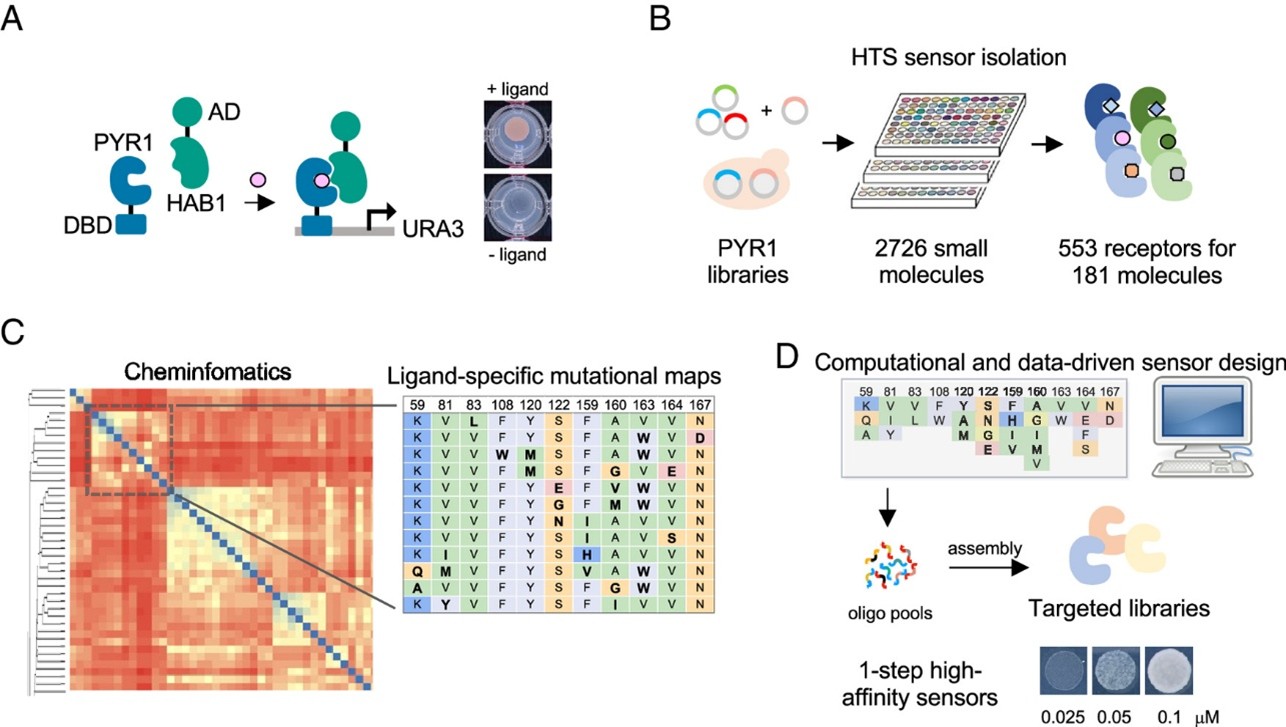 Designing small-molecule biosensors that are both sensitive and versatile remains a central challenge in synthetic biology, yet such tools are indispensable for environmental monitoring, cellular control, and emerging biotechnologies. In this study, Tian and colleagues exploit an unexpected feature of the plant abscisic acid receptor PYR1: its remarkable capacity to accommodate chemically diverse ligands. Previously, as a sensor scaffold for cannabinoids and pesticides, PYR1 demonstrates an unusually malleable ligand-binding pocket that can be reshaped to recognize structurally unrelated compounds. To systematically define the binding scope of PYR1, the authors generated a mutant library and coupled ligand recognition to a yeast reporter system. Upon ligand binding, PYR1 interacts with its effector protein HAB1, activating a pathway that rescues uracil auxotrophy. Screening this system against a diverse panel of 2,726 FDA-approved drugs and natural products yielded 553 functional sensors, corresponding to 6.6% of the tested molecules. Notably, environmentally significant ligands such as the explosive 2,4,6-trinitrotoluene (TNT) and persistent “forever chemicals” known as per- and polyfluoroalkyl substances (PFAS) emerged as prominent targets. Using the mutant collection, the authors further identified high-affinity receptors for these priority compounds. Collectively, this large-scale interaction dataset highlights PYR1 as a powerful and adaptable platform, opening new avenues for data-driven biosensor engineering and the rational design of receptors tailored to pressing environmental and technological needs. (Summary by Ching Chan @ntnuchanlab @ntnuchanlab.bsky.social) PNAS 10.1073/pnas.2519924122