


Sulfur partitioning between glutathione and protein synthesis determines plant growth (Plant Physiol.)
Plant Science Research WeeklySulfur is incorporated into the amino acid cysteine (Cys) and also the reactive-oxygen scavenger glutathione (GSH). Speiser et al. investigated the effect of restricting both Cys and glutathione production through a double-mutant analysis in Arabidopsis; sir1-1 is a slow-growing sulfite-reductase deficient…
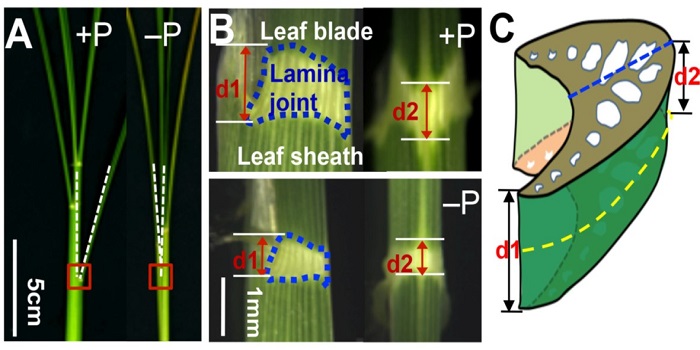
So Inclined: Phosphate Status and Leaf Angle in Rice
Blog, The Plant Cell, The Plant Cell: In BriefWhen plants have plenty of room, they can maximize the incoming light by spreading their leaves. However, in modern agricultural fields, plants that hold their leaves upright to decrease mutual shading can be grown at high density. Leaves serve as a reservoir for nitrogen that can be re-mobilized to…
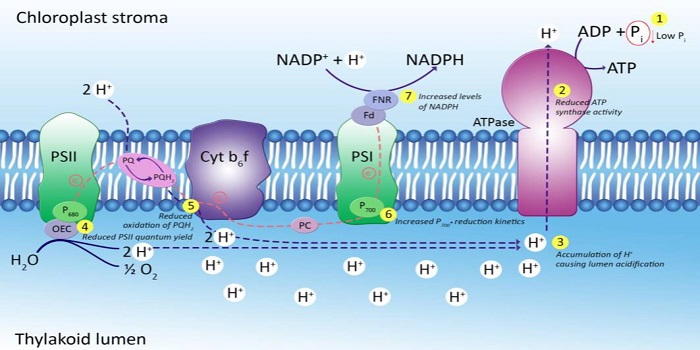
Phosphorous Deficiency and Photosynthesis
Plant Physiology, Plant Physiology: On The Inside, ResearchPhosphorus (P) is an essential macronutrient, and P deficiency limits plant productivity. P influences many aspects of photosynthesis P-deficient plants typically remain green and do not develop leaf chlorosis and yet P starvation immediately affects CO2 assimilation. Specifically, P deficiency is believed…
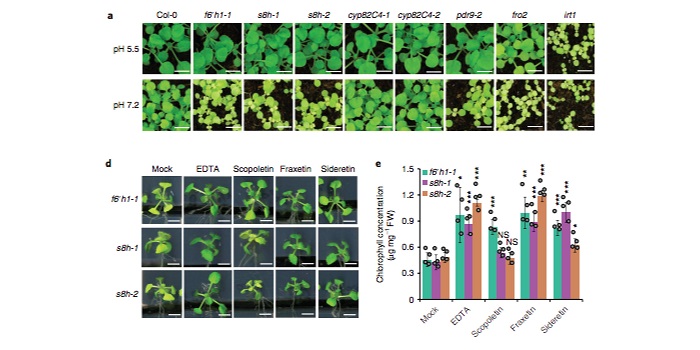
Iron Accumulation and Fraxetin, a Coumarin
Plant Physiology, Plant Physiology: On The Inside, ResearchSoil pH has a strong influence on the availability of mineral nutrients and the distribution of species in natural plant communities. Iron (Fe) solubility decreases dramatically with increasing pH. In alkaline soils, calcifuge (“chalk-fleeing”) species are unable to compete due to their inability…
Biosynthesis of redox active metabolites in response to iron deficiency in plants (Nature Chem Biol)
Plant Science Research WeeklyIron is an essential but poorly bioavailable micronutrient that serves as a co-factor in many processes involved in electron- or oxygen-transfer. Land-plants evolved at least two distinct mechanism for iron uptake based on chelation of iron by phytosiderophores, that are produced only by grasses, or…
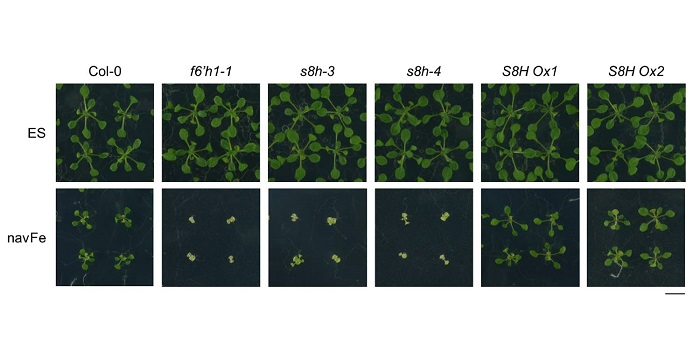
Scopoletin 8-hydroxylase-mediated fraxetin production is crucial for iron mobilization (Plant Physiol)
Plant Science Research WeeklyAs iron is often limiting in the environment, plants use many strategies to support iron uptake, including secretion of small molecules such as coumarins that can help to mobilize iron from the soil. Tsai et al. examined the role of a gene involved in fraxetin (7,8-dihydroxy-6-methoxycoumarin) production…
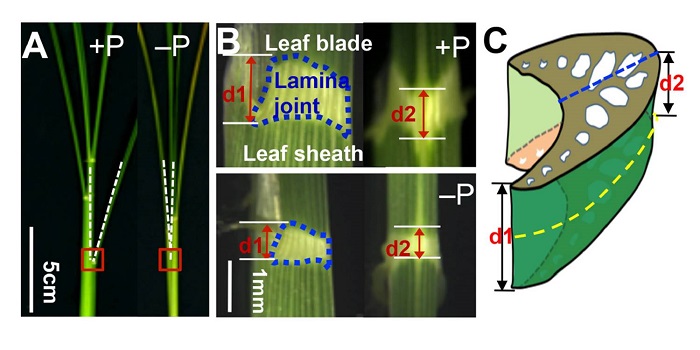
An SPX-RLI1 module regulates leaf inclination in response to phosphate availability in rice (Plant Cell)
Plant Science Research WeeklyThe angle at which a rice leaf bends affects its ability to intercept light and also the density at which the plants can be sown. Previous work has shown that brassinosteroid hormones and the BRASSINOSTEROID UPREGULATED1 (BU1) gene affect leaf angle. Ruan, Guo, Xu et al. investigated the role of phosphate…
The impacts of phosphorus deficiency on the photosynthetic electron transport chain (Plant Physiol)
Plant Science Research WeeklyPhosphorus deficiency is widespread and can severely limit plant growth. Carstensen et al. investigated how P deficiency affects photosynthesis in barley. They compared chlorophyll a fluorescence transients (OJIP transients) between P-deficient, sufficient and resupplied plants. They observed depletion…
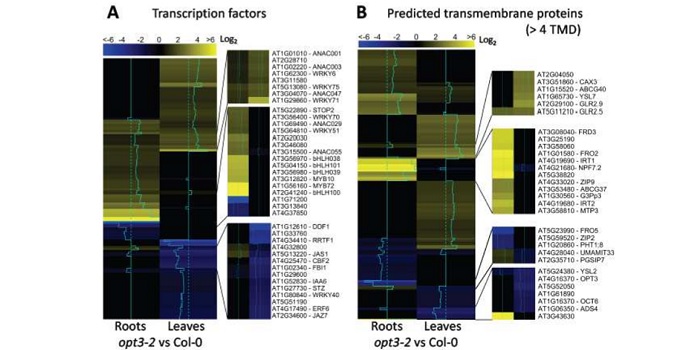
Iron availability sensed in leaf vasculature causes changes in transcriptional programs (Plant Cell Environ)
Plant Science Research WeeklyIron is an essential micronutrient for plants but it is often not bioavailable in the soil. Thus, plants have evolved difference processes for iron sensing and iron uptake. OLIGOPEPTIDE TRANSPORTER 3 (OPT3) is an important iron transporter and is a component of the systemic network that mediates iron…