Mangrove pneumatophore roots engage in salt extrusion
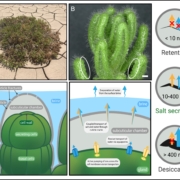
 Mangroves are salt-adapted trees that provide critical habitats for many organisms and stabilize shorelines. They also have several strategies for dealing with the hostile coastal environment that is high in salt and, for the submerged root system, low in oxygen. Pneumatophores are upward-growing components of the root system that have been shown to take up oxygen through small pores called lenticels (corky tissues through which gasses can exchange) and transport it to the below-water roots through aerenchyma (air spaces in the roots). Additionally, pneumatophores themselves can be photosynthetic. In a new study, Huang et al. identified that pneumatophores can also extrude salt. Many salt-tolerant plants extrude salt, but usually this takes place in the shoot system through specialized salt glands. In the mangrove pneumatophores, the authors observed salt crystals accumulating at the surface of the lenticels. Further analysis of ion and ion channel abundance indicate that the salt is transported through xylem from the below-ground part of the pneumatophore to the above-ground part, and then moved outwards from the xylem towards the lenticels. This process increases with increasing salinity, demonstrating a previously-undescribed role for these specialized roots. (Summary by Mary Williams @PlantTeaching.bsky.social) New Phytol. 10.1111/nph.71061