
How salt-extruding halophytes avoid drying out
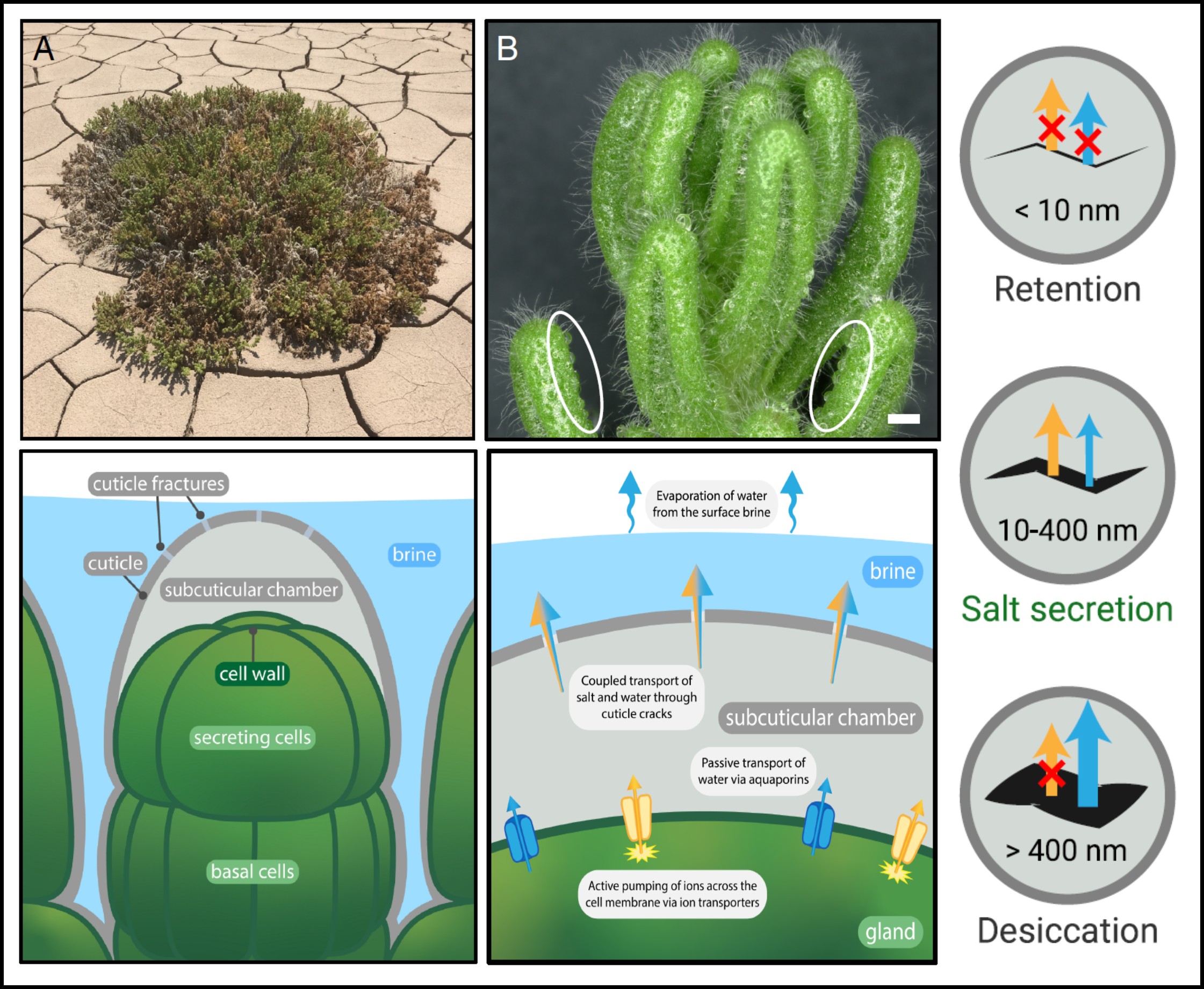 Halophytes are plants that have evolved ways to adapt to high-salt environments that can be toxic to non-halophytes. Some halophytes prevent salt uptake, some sequester it in disposable bladders, and some extrude it from salt glands. In a new study, Mai et al. studied Nolana mollis, a salt-tolerant plant from the Atacama desert in Chile. This plant is coated with a salty brine (>3.5% NaCl) due to salt being extruded from salt glands. The authors found that there is a fluid-filled chamber between the cell membrane and the cuticle. Salt is actively pumped into this chamber, with water following outwards passively down the concentration gradient. The salty water leaks out from the chamber through small cracks in the cuticle, leading to the briny coating which is much saltier than the water in the chamber due to evapotranspiration. The authors investigated how the size of these cuticular cracks affects the plant’s ability to remove salt, and they found that only intermediate sized cracks (10-400 nm) are effective. When the cracks are too small, water and salt can’t escape the chamber and pressure build up too high for it to work, and when they are too large the cuticle fails to prevent catastrophic transpirational water loss. The authors discuss the importance of the fractocohesive strength of the cuticle in maintaining the appropriate crack size, and note that their findings can be useful when developing biomimetic desalinizers or engineered salt-tolerant plants. (Summary by Mary Williams @PlantTeaching.bsky.social) PNAS 10.1073/pnas.2505598122