Insights into pyrenoid structure
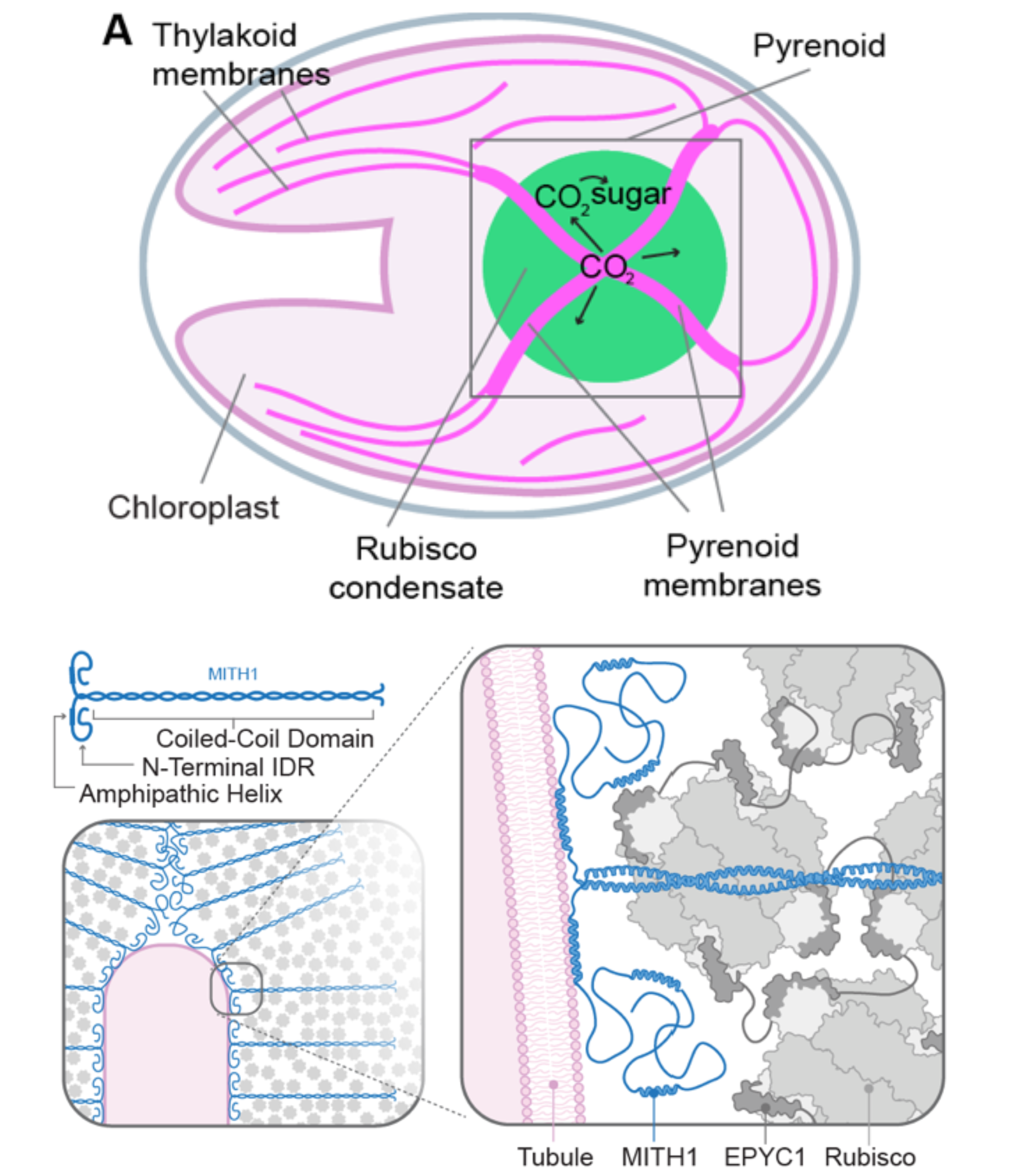 As close relatives of land plants, green algae provide insights into variations on photosynthesis. Many algae including Chlamydomonas reinhardtii have carbon-concentrating structures called pyrenoids that enrich CO2 around Rubisco, minimizing the competing oxygenation reaction. In a recent preprint, Ergun et al. investigated the structure of the pyrenoid, particularly how the tubules containing CO2 are integrated into the molecular condensate composed of Rubisco. Previously, they had identified a mutant in MITH1 that is devoid of the condensate-penetrating tubules, suggesting that this protein is necessary for their formation. In their new work, they used cryo-EM and fluorescent labelling to analyze pyrenoids in various deletion mutants of MITH1. The protein has an intrinsically disordered domain at the N-terminus, followed by a domain that forms an amphipathic helix, and then domain that dimerizes as a long coiled-coiled regio. The data reveal that the MITH1 protein binds to the tubules with the amphipathic helix region, and that the coiled-coiled domain extends outward from the tubules and binds to Rubisco in the condensate. These insights reveal how MITH1 promotes tubule entry and organization within the condensate of the pyrenoid, enhancing photosynthetic efficiency. (Summary by Mary Williams @PlantTeaching.bsky.social) bioRxiv https://www.biorxiv.org/content/10.64898/2026.06.09.731149v1