
A new technology holds promise for Lunar nitrogen fertilizers
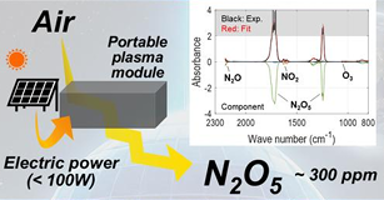 Plasma technology utilizes high-energy electrons to make nitrogen and oxygen gases from the atmosphere react with each other in order to produce various nitrogen oxide species. This technology can recreate the essential reactions underlying nitrogen fixation, through which nitrogen found in inert N2 atmospheric gas is converted into readily accessible forms such as nitrogen oxides for plants to assimilate. One such nitrogen oxide produced by this technology is dinitrogen pentoxide (N2O5), which Kaneko and colleagues applied as a gas or in dissolved water to rice seedlings grown in simulated Lunar crushed rock called regolith. They subsequently quantified gene expression levels, fresh weight, and fresh weight per unit length. The addition of N2O5-dissolved water reduced the alkaline pH of the regolith and significantly increased the elution of metal ions in the regolith coming from potassium, magnesium, and calcium oxides, providing the appropriate minerals for the plants to grow. The researchers observed that applying N2O5 gas to leaves triggers jasmonic acid and ethylene phytohormone pathways as well as increases systemic resistance and the production of secondary metabolites involved with lignin and flavonoid synthesis. Overall, this sustainable plasma technology has the capability to help improve the impact of nitrogen fertilizer on plant success, even in harsh Lunar conditions. (Summary by Ruth Nichols). npj Microgravity. 10.1038/s41526-026-00602-3