
Fast cell wall softening powers Venus flytrap closure
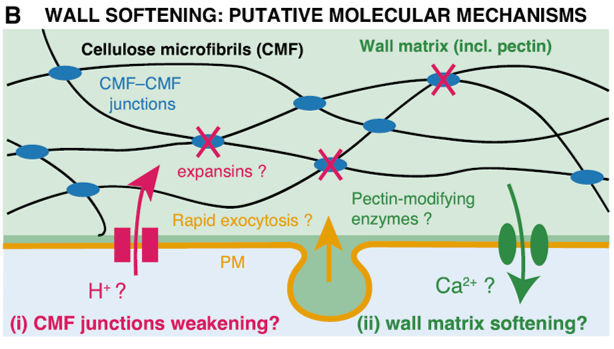 We are used to thinking of plants as slow-moving organisms, so the few exceptions that exist are not only fascinating curiosities but also scientific mysteries waiting to be resolved. The Venus flytrap is one of the most studied fast-moving plants. Until now, the rapid closure of its trap was thought to be driven primarily by water movement. In their new paper, Ryu et al. challenge this idea by analyzing the hydraulic and mechanical properties of the trap. They show that the key mechanism behind the release of the stored elastic energy is a rapid softening of the epidermal cell wall. This change in stiffness is the fastest ever recorded in plant cell walls. What molecular mechanisms could produce such a rapid response? The authors propose several possibilities, including calcium-mediated modifications of the pectin matrix, changes in the mechanical connectivity of the cellulose microfibril network, and the action of wall-loosening proteins such as expansins. The authors note that transgenic lines and mutants are already available, and we look forward to the insights they will provide into the molecular basis of this extraordinary feat of plant biomechanics. By demonstrating that ultrafast cell wall softening, not hydraulic flow, triggers trap closure, this study reshapes the mechanistic framework for rapid plant movements and highlights the dynamic potential of plant cell walls. (Summary by Ale Lombardi @alepanda.bsky.social) Science, 10.1126/science.aed5051