

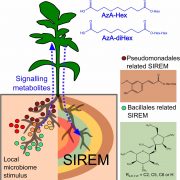
Rhizosphere microbiome mediates systemic root metabolite exudation ($) (PNAS)
Plant Science Research WeeklyRoots exude metabolites that affect the composition and activities of their microbiome. Korenblum et al. show that the microbiome in turn affects metabolite exudation, not only locally but also systemically (shown using a split-root system). They call this response SIREM: systemically induced root exudation…
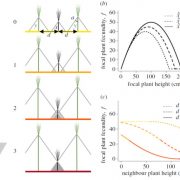
Farming plant cooperation in crops (Proc. R. Soc. B.)
Plant Science Research WeeklyIf you want a great plant, select for a strong, vigorous, high-yielding individual; this is also the outcome of natural selection. But if you want a great field of plants, these traits may not be as suitable, because the plants will expend energy competing between themselves. When seeds from many plants…
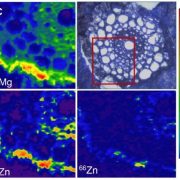
Plant Science Research Weekly: February 14
Blog, WWR Full PostReview: Deep learning for plant genomics and crop improvement
One of the goals of plant science is to use the molecular phenotype (genome, transcriptome, proteome) to predict the whole-plant phenotype. Deep learning approaches can potentially begin to do this, starting with a training dataset, and…
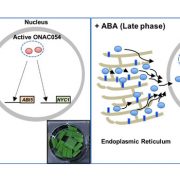
Multilayered Regulation in Senescence
Research, The Plant Cell, The Plant Cell: In a NutshellSakuraba et al. show the existence of multilayered regulation systems for the rice ONAC054 transcription factor, which is involved in abscisic acid-induced leaf senescence in rice. Plant Cell https://doi.org/10.1105/tpc.19.00569
By Nam-Chon Paek, Department of Plant Science, Seoul National University,…
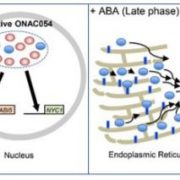
Make, Modify, Move: Multilayered Regulation of ONAC054 During ABA-Induced Leaf Senescence
Research, The Plant Cell, The Plant Cell: In Brief‘Senescence’ originates from the Latin word senescere, to grow old. However, the process of leaf senescence is not simply the passive death of the leaf but instead represents an active and highly regulated process of nutrient remobilization from older leaves into developing parts of the plant to…
Rapid changes: ABA-independent SnRK2s target mRNA decay
Plant Physiology, Plant Physiology: News and Views, ResearchMagda Julkowska
Magdalena.Julkowska@kaust.edu.sa
In response to stress, secondary messengers and rapid and reversible protein phosphorylation contribute to signaling cascades that generate unique signatures indicating stress type and severity. Activation of stress-induced signaling cascades…

MED25 regulates the alternative splicing of JAZ genes through recruitment of splicing factors PRP39 and PRP40
Research, The Plant Cell, The Plant Cell: In a NutshellWu et al. investigated MED25 recruits splicing factors to regulate the alternative splicing of JAZ genes in Arabidopsis. The Plant Cell (2019). https://doi.org/10.1105/tpc.19.00583
Background: The jasmonate (JA) signaling pathway controls resource allocation between growth- and defense-related…

A Novel Regulatory Mechanism in Plant Innate Immunity
Research, The Plant Cell, The Plant Cell: In a NutshellXing et al. use advance microscopy to show that phospholipase D functions in the response to powdery mildew. Plant Cell https://doi.org/10.1105/tpc.19.00534
by Jingjing Xing, Xiaojuan Li, Xiaohua Wang, Xueqin Lv, Li Wang, Liang Zhang, Yingfang Zhu, Qianhua Shen, František Baluška, Jozef Šamaj,…

Recognizing Plant Physiology authors: Marcus Griffiths
Plant Physiology, Plant Physiology: Author ProfilesMarcus Griffiths, first author of Targeting root uptake kinetics to increase plant productivity and nutrient use efficiency
Current Position: Postdoctoral Fellow in the Root Phenomics lab headed by Dr. Larry York, Noble Research Institute, US
Education: PhD in Plant & Crop Sciences at University…