

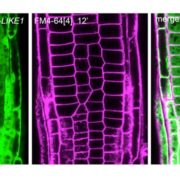
A functional study of AUXILIN-LIKE1 and 2, two putative clathrin uncoating factors in Arabidopsis (Plant Cell)
Plant Science Research WeeklyTrafficking within a cell can occur through clathrin-mediated endocytosis (CME). CME depends upon coating plasma membrane vesicles with clathrin and adaptor proteins but the mechanism is unclear in plants. Adamowski et al. establish a means with which to study this process in order to further elucidate…

Membrane protein MHZ3 stabilizes OsEIN2 in rice by interacting with its Nramp-like domain (PNAS)
Plant Science Research WeeklyMuch of the ethylene biosynthesis and signaling pathway has been characterized from study of the dicot Arabidopsis. In this study, Ma et al. have characterized the ethylene insensitive mutant mhz3 from rice. MHZ3 is a membrane protein localized to the endoplasmic reticulum that interacts with OsEIN2…
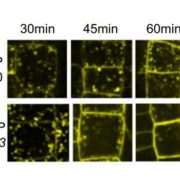
Regulation of Arabidopsis Brassinosteroid receptor BRI1 endocytosis and ubiquitination ($) (PNAS)
Plant Science Research WeeklyBRI1 (BRASSINOSTEROID INSENSITIVE1) is a plasma-membrane localized brassinosteroid (BR) receptor that is endocytosed to internal membranes following BR binding. In this study, Zhou, Liu et al. provide a mechanistic model of BRI1 endocytosis through ubiquitination. They identified two E3 ubiquitin ligases,…
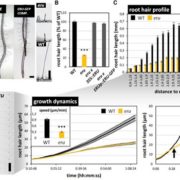
The auxin-regulated CrRLK1L kinase ERULUS controls cell wall composition during root hair tip growth ($) (Curr Biol)
Plant Science Research WeeklyRoot hair outgrowth requires the plant hormone auxin and polarized tip growth and cell wall deposition. Schoenaers et al. showed that the plasma membrane-localized receptor-like kinase ERULUS (ERU) regulates tip growth in root hairs. ERU is regulated by auxin via ARF7 and ARF19 transcription factors,…
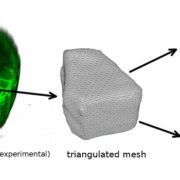
A computational framework for cortical microtubule dynamics in realistically shaped plant cells (PLOS Comp Biol)
Plant Science Research WeeklyPlant growth and development consist of highly organized cellular patterns and depend on the directional growth and orientation of cells. Understanding microtubule dynamics is key to deciphering the formation of cellular shape and growth direction. In this research, Chakrabortty et al. employed analytical…
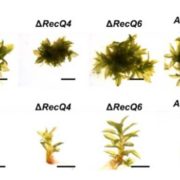
What we're reading: March 16th
WWR Full PostLetters: Auxin and vesicle traffic
Three letters to Plant Physiology address the role of vesicles in auxin transport, discussing the evidence and conclusions from a recently published paper from three perspectives. Does auxin accumulate in endocytic vesicles? If so, how, and why? The Letters address…
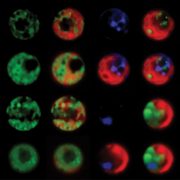
Saving Algae from Environmental Stresses
Research, The Plant Cell, The Plant Cell: In a NutshellDu et al. investigate an important protein that regulates photosynthesis under stress. Plant Cell. https://doi.org/10.1105/tpc.17.00446.
Background:…
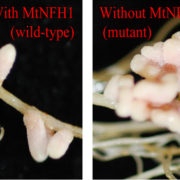
Nodule Symbiosis: Cleavage of Bacterial Signals Affects Nodule Shape
Research, The Plant Cell, The Plant Cell: In a NutshellCai et al. investigate the function of a Medicago truncatula enzyme (MtNFH1) that cleaves nodulation signals of symbiotic Sinorhizobium meliloti bacteria. Plant Cell (2018). https://doi.org/10.1105/tpc.17.00420.
By Jie Cai, Zhi-Ping Xie and Christian Staehelin
Background: Nitrogen-fixing rhizobia…
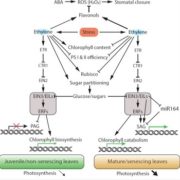
Update: Ethylene exerts species-specific and age-dependent control of photosynthesis
Blog, Plant Physiology, Plant Physiology: UpdatesBy Johan Ceuster and Bram Van de Poel
Abstract
The volatile plant hormone ethylene plays a regulatory role in many developmental processes and in biotic and abiotic stress responses. One of the under-explored actions of ethylene is its regulation of photosynthesis and associated components such…