
Under attack: One reason why plants struggle in a warmer world
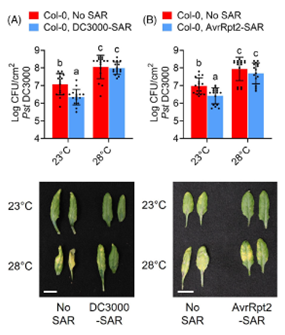 Plants, like animals, have a natural immune system that helps them defend against diseases. They not only fight local pathogens but can also alert distant, non-infected tissues to prepare for infection, a process called systemic acquired resistance (SAR). All these mechanisms can be threatened by climate change, especially by high temperatures. Shields et al. showed that as temperatures rise, plants struggle to activate their SAR mechanisms following pathogen attack. In simple terms, warmth makes it harder for plants to warn other parts of themselves, leaving them more vulnerable overall. In this study, the researchers infected individual leaves of Arabidopsis thaliana with the non-virulent bacteria Pseudomonas syringae and, two days later, reinfected other leaves with virulent pathogens to analyze resistance and SAR activation. Under normal (23 °C) conditions, infection triggered the production of N-hydroxypipecolic acid (NHP), a key immune signal. However, at 28 °C, plants failed to accumulate NHP due to reduced activity of the biosynthetic genes ALD1 and FMO1. Heat also suppressed ICS1, a gene that drives the synthesis of the defense hormone salicylic acid (SA) and lowered the expression of the master immune regulators CBP60g and SARD1, which control both NHP and SA pathways. These findings reveal that climate warming directly interferes with the molecular machinery of plant immunity, highlighting the need to engineer crops with heat-resilient immune networks. (Summary by Carlos González Sanz @carlosgonzsanz). Plant J. (10.1111/tpj.70374)