
When roots call, microbes answer: Glutamine as a key signal for microbial attraction
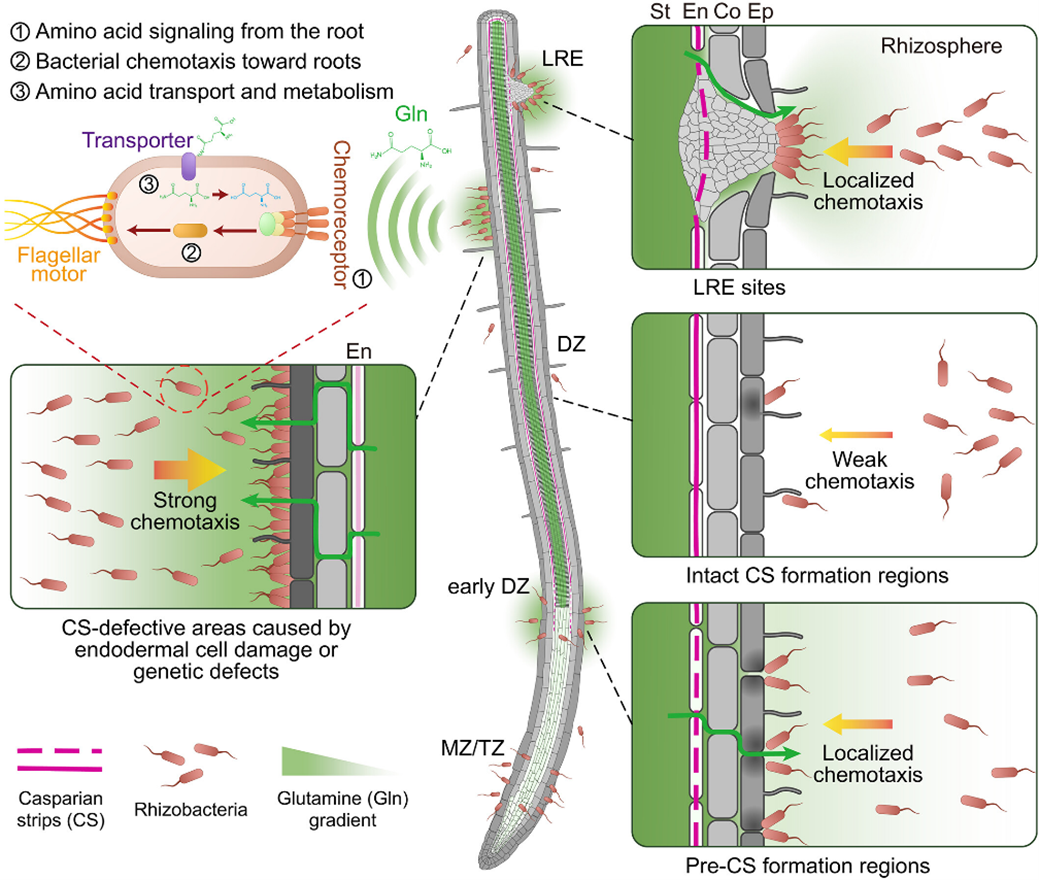 Plants don’t grow alone. They cultivate vibrant microbial communities around their roots that shape their growth, health, and resilience. Root exudates, cocktails of secreted metabolites, play a key role in selectively recruiting beneficial soil bacteria. Yet when, where, and how these exudates are released within the root system has remained largely unknown. Using an in-house mini-hydroponics setup, Tsai and colleagues visualized fluorescently-labeled bacteria colonizing specific root zones. They found that colonization peaks at the meristematic and transition zones, before the endodermal Casparian strip forms, while mature root regions show little bacterial presence other than in regions where lateral roots emerge and the Casparian strip is interrupted. Mutants with defective endodermal barriers (sgn3 and myb36) and laser ablation experiments confirmed that exudate leakage through the defective endodermis drives bacterial attraction. Through metabolomics and mutant analyses, the team identified glutamine as a key chemoattractant, a finding reinforced by glutamine-feeding and transporter-overexpression experiments. Although visualizing amino acid leakage in situ remains technically challenging, this work unveils compelling evidence and powerful tools to decode how roots orchestrate microbial partnerships, paving the way for designing crops that better harness the soil microbiome for sustainable agriculture. (Summary by Ching Chan @ntnuchanlab) Science 10.1126/science.adu423