MSL10 and the Prey: A high-sensitivity mechanosensor in Venus flytrap
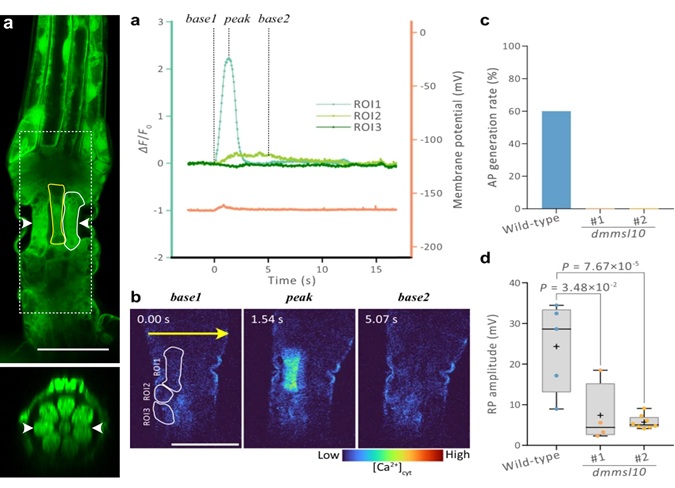 Plants are sessile and must sense and adapt to environmental stresses, including mechanical forces from wind or physical contact. Mechanosensitive genes, such as those in the Mechanosensitive channel of Small conductance-Like (MSL) family, prevent cell rupture by acting as osmotic safety valves under stressful conditions. In this study, Suda et al. investigated the role of MSL10 in the sensory hairs of Venus flytrap, which contain mechanosensitive cells in their basal indentation zones. Mechanical stimulation triggered calcium increases in indented cells on the stretched side, with small deflections leading to signal propagation to adjacent cells, and large deflections extending to surrounding cells. Single-cell destruction by laser ablation confirmed that these calcium signals originated from the indented cells. Stimulating the sensory hairs from different directions consistently triggered calcium increase at the indented cells, supporting a two-stage sensing model: (i) mechanical perception in indented cells, and (ii) multicellular signal propagation. Since electrical potential changes are also generated in response to mechanical stimuli, the authors investigated the relationship between the calcium signals and electrical signals. They identified receptor potentials (RPs) which are associated with local calcium signals, and action potentials (APs) associated with long-range propagation. MSL10 is an anion channel enriched in indented cells and utilized in long-range calcium signal propagation. The authors found that MSL10 mutants showed reduced trap closure when stimulated by ants compared to the wild-type, suggesting that MSL10 contributes to prey capture in Venus flytrap. (Summary by Irene I. Ikiriko @ireneikiriko) Nature Comms. 10.1038/s41467-025-63419-w.