
The role of AGO10 in plant immunity via trans-species RNA interference
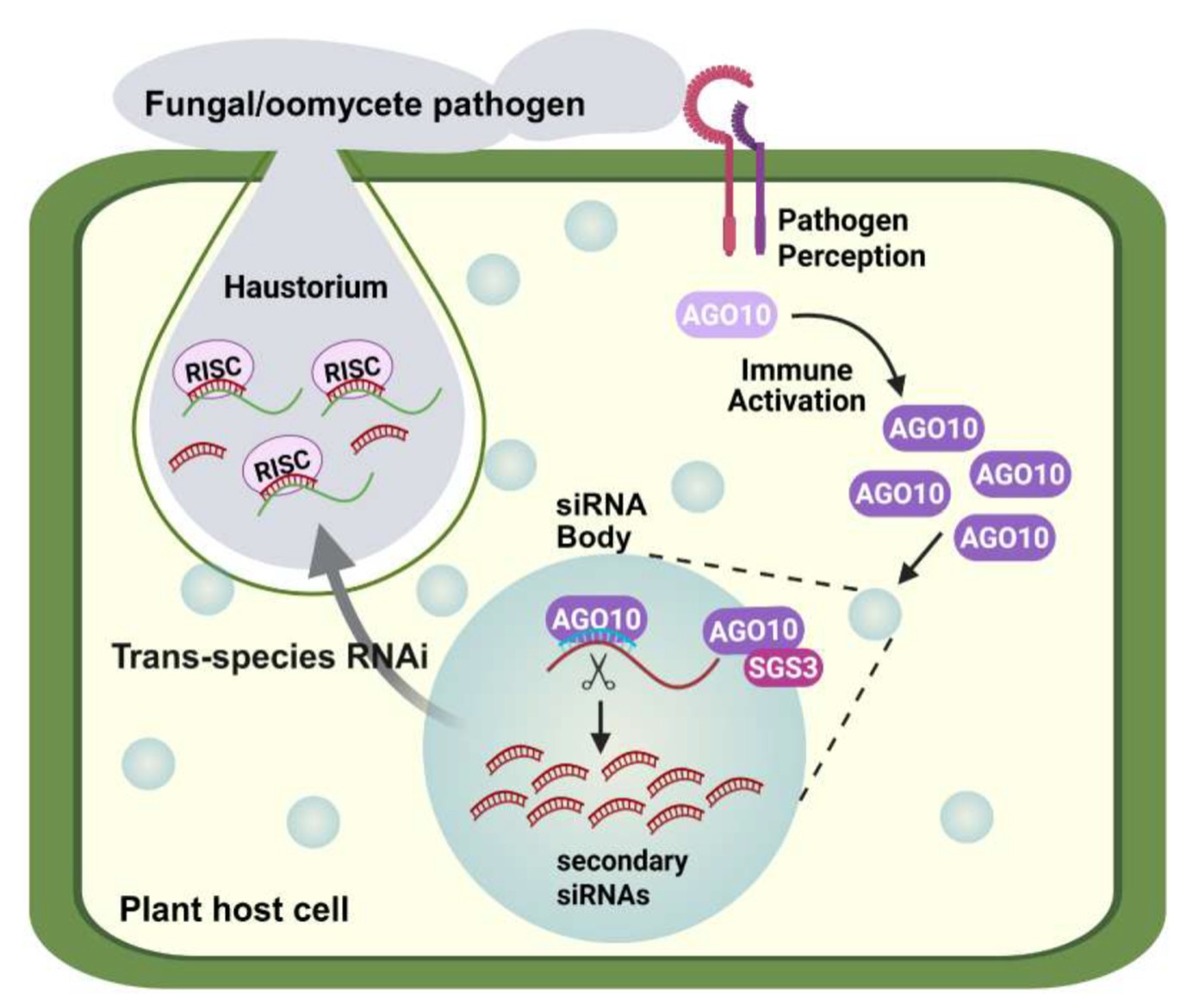 In this preprint, Wang et al. unravel a novel role for ARGONAUTE10 (AGO10) in plant immunity. Specifically, they found that AGO10 is involved in trans-species RNA interference (tsRNAi), a mechanism plants use to silence target genes in pathogens. Upon Phytophthora capsici infection, two distinct ago10 mutants are significantly more susceptible to the pathogen compared to wild-type plants. By evaluating the abundance of two siRNAs involved in P. capsici defense, they discovered that the infection-induced upregulation observed in WT plants is abolished in ago10 mutants. Remarkably, after pathogen perception, AGO10 proteins rapidly accumulate, even though their mRNA levels remain unchanged. The accumulated AGO10 proteins relocalize into liquid-like cytoplasmic condensates, also referred to as puncta. Cytoplasmatic puncta are localized in plant cells situated near the infection site and in direct contact with the invasive hyphae. The dynamic responsiveness relies on an intrinsically disordered region (IDR) at the N-terminus of the AGO10a protein. This IDR is essential for AGO10 interaction with SGS3, which is a key scaffolding component of siRNAs bodies. AGO10-SGS3 interaction is necessary for recruiting AGO10 into these condensates, where AGO10 effectively promotes the production of defensive secondary siRNAs. Finally, these small RNAs mediate the silencing of specific pathogen virulence genes. (Summary by Emma Olmi @olmiemma.bsky.social) bioRxiv https://doi.org/10.64898/2026.02.18.706620