
Closing the gates: Plasmodesmal closure triggers stress responses
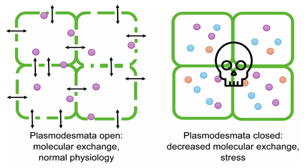 Plasmodesmata are membrane-lined bridges between adjacent plant cells that control the exchange of signaling molecules and nutrients between neighbouring cells. Biotic stress is known to cause the rapid closure of plasmodesmata via callose deposition; however, its precise role in immune responses remains unclear. In a recent study, Tee et al. demonstrated that plasmodesmal closure is sufficient to activate stress-signaling using inducible Arabidopsis lines that promote plasmodesmata closure independent of stress elicitors. Transcriptomic analyses revealed that prolonged closure upregulates defense-related genes. Increased salicylic acid biosynthesis and signaling in transgenic lines suggested that closure alone can activate stress signaling in the absence of external elicitors. The authors further showed accumulation of sugars in transgenic lines, indicating a metabolic imbalance accompanied by growth defects and signs of senescence. Surprisingly, photosynthetic efficiency remained unchanged, suggesting that sugar accumulation results from impaired symplastic transport. To further establish functional significance, the authors performed pathogen assays that showed plasmodesmal closure enhanced resistance to the biotroph Pseudomonas syringae DC3000 but increased susceptibility to the necrotroph Botrytis cinerea. The authors proposed that accumulated sugars may provide a nutrient source for necrotrophs, while SA signaling enhances resistance against biotrophic pathogens. Taken together, this study establishes that cell connectivity is crucial for optimum plant function, and plasmodesmal closure itself acts as an activator of stress signaling. (Summary by Priyanka Babuta) EMBO Reports 10.1038/s44319-026-00789-2