
The architecture of the cell-to-cell message channel
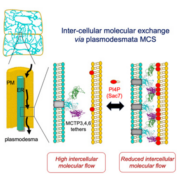
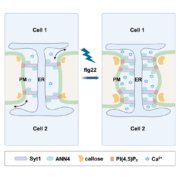
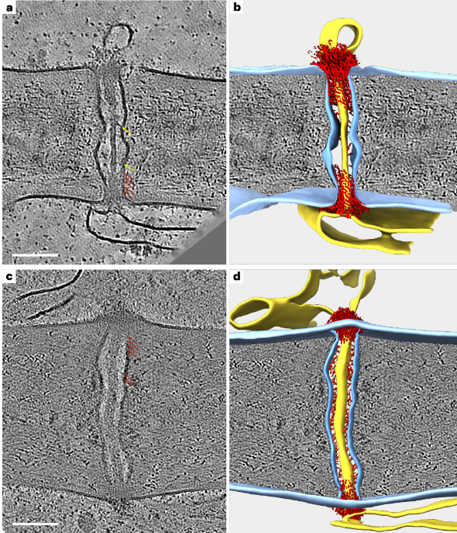 Cells communicate with one another to coordinate signaling across tissues. Adjacent cells are connected by plasmodesmata that create a cellular continuum throughout the plant. Although many plasmodesmata-associated proteins have been identified, details of structure remain unclear. Techniques often used, such as fluorescence microscopy, electron microscopy, and electron tomography, have helped to determine how these structures form and what they look like. However, these approaches are limited in the structures that can be resolved. By contrast, new advances in cryo-electron tomography (cryo-ET) allow sample processing in their native cellular context. In this study, the authors investigated the structure of plasmodesmata and their regulation in the moss Physcomitrium patens. This species shows a typical plasmodesmata architecture, with a cell cavity lined by the plasma membrane and containing a tubular extension of the endoplasmic reticulum. As part of the ABA response, plants accumulate callose on both sides of these channels to regulate their opening. In this paper, the authors show that local remodeling of the cell wall forms an apoplasmic gate can of fully close plasmodesmata. (Summary by Montserrat López-Coria). Nature Plants 10.1038/s41477-026-02294-9